WHY BONUSES DON’T CHANGE FRONTLINE BEHAVIOR


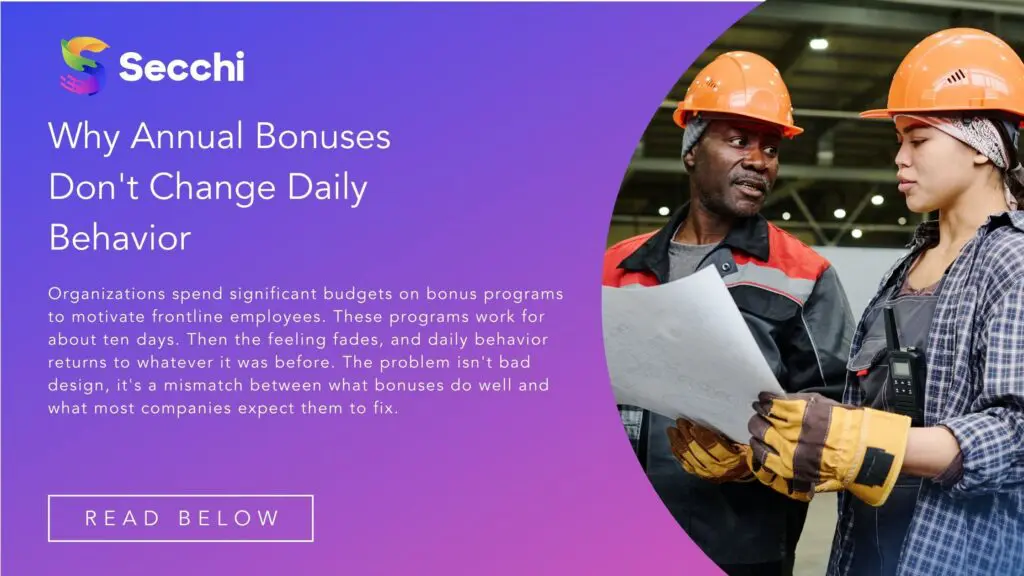
Every year, organizations spend significant budgets on bonus programs designed to motivate frontline employees. Year-end payouts. Quarterly profit-sharing distributions. Annual goal-based incentives.
These programs work exactly as intended for about ten days.
The employee who receives a bonus feels genuinely good about it. They feel valued. They might even feel more connected to the company’s success for a short period. Then the feeling fades, and their day-to-day behavior returns to whatever it was before the bonus arrived.
This isn’t a failure of bonus program design. It’s a fundamental mismatch between what bonuses are good for and what most organizations are trying to use them for.
Bonuses are an effective mechanism for sharing in collective goals and profit. They tell employees the organization succeeded and they were part of it. That’s a legitimate and valuable thing to communicate once or twice a year.
What bonuses cannot do is change how an employee shows up on a random Tuesday in March. They cannot make someone more likely to catch a quality issue before it becomes a defect, more likely to show up reliably when a minor obstacle makes attendance inconvenient, or more likely to help a struggling teammate without being asked.
Those behaviors are shaped by something else entirely: what gets noticed, and when.
What Bonuses Are Actually Good For
Understanding why bonuses fail at behavior change starts with understanding what they’re actually designed to do.
Sharing in Collective Outcomes
A bonus tied to company performance, plant performance, or team performance is fundamentally a profit-sharing mechanism. It tells employees that the organization did well and they’re getting a piece of that success.
This serves a real purpose. It reinforces the connection between individual effort and collective outcome at a macro level. It can support retention by giving employees a financial reason to stay through the payout period. It signals that the organization views its workforce as a stakeholder in results, not just a cost.
None of this is wrong. It’s simply a different function than changing daily behavior.
The Ten-Day Window
The emotional lift from receiving a bonus is real but short-lived. Behavioral research on reward timing consistently shows that the motivational effect of a reward decays rapidly once the reward is delivered, particularly when the reward is disconnected from the specific behavior that earned it.
An employee who receives an annual bonus in December doesn’t experience a sustained shift in their daily conduct through the following March.
The bonus was earned by twelve months of aggregate performance, but it’s delivered as a single event. The connection between any specific day’s behavior and the reward is too diffuse to reinforce anything specific.
This is why the feeling fades in about ten days. The bonus did its job: it communicated appreciation for a year of work. It was never positioned to do the job most organizations hope it will do, which is to drive daily behavioral consistency.
Why Day-to-Day Behavior Requires a Different Mechanism
Daily behavior, whether an employee shows up reliably, catches a quality issue, helps a teammate, or follows a safety procedure under production pressure, responds to a completely different psychological mechanism than annual compensation.
The Specificity Requirement
Behavioral reinforcement works best when it is immediate and specific. The employee needs to understand exactly what they did that mattered, and they need to understand it close to the moment they did it.
A bonus delivered in December for a quality catch made in February cannot reinforce the quality catch, because the temporal and conceptual distance between the behavior and the reward is too large for the employee’s brain to connect them meaningfully.
By contrast, a supervisor who says, “I saw you catch that measurement issue before it became a problem, that kind of attention is exactly what keeps our quality numbers where they need to be,” delivered within hours of the behavior, creates a direct and specific connection.
This specificity is what teaches an employee precisely which behaviors the organization values. Generic appreciation
The Visibility Mechanism
Underlying daily behavioral consistency, particularly attendance reliability, is a need that most compensation structures don’t address: the need to feel that one’s presence and contribution are noticed.
An employee deciding whether to push through a minor obstacle to make it to work is making a calculation, often unconsciously, about whether their presence matters.
If they believe no one will notice the difference, the calculation tilts toward staying home. If they believe their supervisor will notice, and has noticed before, the calculation tilts toward showing up.
A once a year bonus does nothing to inform this daily calculation. In-the-moment recognition does, because it provides continuous evidence that someone is paying attention.
The Behavioral Data
The relationship between recognition frequency and behavioral outcomes is measurable, and the data consistently favors frequent, specific recognition over infrequent, generic compensation events.
Facilities that increased recognition activity by more than 200% saw attendance events drop by 50% and disciplinary events drop by 70% over a comparable period. These are not modest effects. They reflect a fundamental shift in daily behavior that no bonus structure, however generous, has been shown to produce on its own.
This data doesn’t suggest organizations should eliminate bonuses. It suggests that if the goal is changing daily behavior rather than sharing in annual outcomes, recognition frequency is the lever that actually moves, and bonus magnitude is not.
The Operational Cost of Relying on Bonuses Alone
When organizations rely primarily on bonus structures to drive engagement and behavior, the gap between intention and outcome shows up in predictable ways.
The Attendance Gap
Perfect attendance bonuses are a common attempt to use compensation to solve a behavioral problem. The structure assumes that a financial incentive at the end of a quarter will change an employee’s daily decision-making about whether to show up.
For employees who already have strong attendance, this incentive simply rewards existing behavior. For employees with chronic attendance challenges, often driven by disengagement, transportation barriers, or caregiving responsibilities, a quarterly bonus rarely changes the underlying calculation.
The barrier or disengagement that’s driving the absence doesn’t disappear because a financial reward exists three months away.
Facilities that have compared attendance incentive programs against recognition infrastructure consistently see the same pattern: incentives produce 5-10% improvement concentrated among employees who already had solid attendance.
Recognition produces 25-30% improvement that includes employees with chronic attendance challenges, because it addresses engagement rather than offering a delayed financial calculation.
The Quality Gap
The same dynamic plays out in quality behavior. An annual bonus tied to plant-wide quality metrics does not give an individual employee a reason to take the extra ten seconds to double-check a measurement on a random Tuesday.
The connection between that specific action and the eventual bonus is too distant to influence the decision.
What does influence that decision is whether the employee believes someone notices when they take that extra care, and whether that noticing has happened consistently enough to become an expectation rather than a surprise.
The Engagement Gap
Perhaps the most significant cost of bonus-only strategies is what they communicate by omission. An organization that only acknowledges contribution once a year, through a payout disconnected from specific behavior, implicitly tells employees that day-to-day effort goes unnoticed except in aggregate.
This produces the disengagement that drives voluntary turnover. Employees who feel that their daily contributions are invisible except at bonus time are experiencing exactly the visibility gap that recognition research consistently identifies as a leading predictor of resignation.

Building Recognition Infrastructure That Actually Changes Behavior
If bonuses aren’t the lever for daily behavior, the practical question becomes how organizations build the infrastructure to deliver specific, in-the-moment recognition consistently across large frontline teams.
The Specificity Standard
Effective behavioral recognition names the exact action and its impact. “Great job today” doesn’t teach an employee anything they can repeat deliberately. “The way you flagged that inventory discrepancy before the shipment went out saved us a serious customer issue” tells the employee precisely what mattered and why.
Supervisors need both the habit and the language to deliver this kind of specificity. Generic praise is easier to default to under time pressure, which is exactly why most frontline recognition trends toward the generic unless there’s a structure encouraging specificity.
The Frequency Standard
Recognition that happens once a quarter, even if specific, doesn’t produce the same effect as recognition that happens weekly or more. The 200% increase in recognition activity that correlates with the attendance and discipline improvements described earlier is a frequency increase, not a magnitude increase.
This means the operational priority isn’t finding bigger rewards. It’s finding ways to make smaller, specific acknowledgments happen more often, across every employee, not just the ones who create urgency through exceptional performance or visible problems.
The Scale Problem
The reason most frontline supervisors don’t deliver frequent, specific recognition isn’t a lack of belief in its value. It’s that tracking who has and hasn’t been recognized across 25 to 30 direct reports, while managing production demands, is not something memory reliably supports.
This is an infrastructure problem, not a willpower problem. Supervisors need systems that surface who hasn’t been acknowledged recently, make recognition fast enough to deliver in the moment rather than after the fact, and capture the recognition that happened so patterns become visible over time.
When recognition takes 90 seconds from a phone instead of requiring a separate administrative process, supervisors can deliver the frequency and specificity that actually drives behavioral change, without that effort competing with their operational responsibilities.
Bonuses and Recognition Are Not Competing Strategies
None of this is an argument against bonus programs. Profit-sharing and goal-based bonuses serve a legitimate purpose: communicating that the organization’s success is shared, and reinforcing the connection between collective effort and collective outcome.
The mistake is asking a once-a-year compensation event to do the job that only continuous, specific, in-the-moment recognition can do. Bonuses reward outcomes after the fact.
Recognition shapes the behaviors that produce those outcomes, every single day, in a way no bonus structure was ever designed to do.
Organizations that want better daily behavior, more reliable attendance, stronger quality ownership, more consistent safety vigilance, need to invest in the infrastructure that makes frequent, specific recognition achievable at scale.
Bonuses can stay. They were just never the answer to the question most organizations were asking of them.
Ready to build the recognition infrastructure that actually changes daily behavior? Explore how Secchi makes specific, in-the-moment recognition achievable across every shift at secchi.io.
About Secchi: Secchi is the only system that captures supervisor behavior at the source. Organizations using Secchi deliver specific, frequent recognition that drives measurable daily behavioral change, including a 200% increase in recognition activity correlated with 50% fewer attendance events and 70% fewer disciplinary events.
Learn more at secchi.io.
Related Resources:
- The Invisible Employee Problem: Why Your Best Workers Leave Without Warning
- What the Data Says About Supervisor Behavior and Operational Outcomes
- How to Measure Frontline Supervisor Effectiveness
- ROI Calculator: What Is Frontline Turnover Actually Costing You?
- Customer Case Studies: ASSA ABLOY, Hispanic Cheese Makers
See how Secchi can drive positive change in your organization.
With Secchi, leaders across your entire organization have access to turn-by-turn leadership directions and actionable data that guides them on how to engage their teams through recognition, coaching, engagement, and accountability.
Want more leadership and engagement strategies straight to your inbox?
Subscribe here.