How to Measure Frontline Supervisor Effectiveness


Ask most operations leaders how they evaluate their frontline supervisors, and the answer comes quickly: production numbers. Did the line hit the target? Did the shift meet its quota? Did the quality metrics stay within tolerance?
These numbers matter. They’re also measuring the wrong thing if the question is supervisor effectiveness specifically.
Production output is a team metric, not a leadership metric. A supervisor can hit production targets for months while their team’s underlying engagement deteriorates, recognition gaps widen, and turnover risk builds, none of which shows up in the output number until it’s already a crisis. By the time the production numbers reflect the leadership problem, the problem has been compounding for weeks.
This is the structural flaw in how most organizations evaluate frontline leadership. They measure the outcome the team produces and call it supervisor performance, when the actual supervisor-specific behaviors that determine whether that outcome is sustainable, coaching frequency, recognition consistency, documentation discipline, check-in cadence, go entirely unmeasured.
Two supervisors with identical production numbers this quarter can be running fundamentally different operations: one building a team that will keep performing, the other depleting a team that’s about to start losing people. Production data alone can’t tell you which is which.
Why Production Output Isn’t a Supervisor Metric
Understanding why output-based evaluation fails requires separating what a team produces from what a supervisor specifically contributes to that production.
Output Reflects the Team, Not the Leadership
A production number is the aggregate result of every person on a shift doing their job, the equipment functioning correctly, the materials arriving on time, and dozens of variables that have nothing to do with supervisory behavior. A supervisor managing a team of highly experienced, self-directed employees can post strong numbers with minimal active leadership. A supervisor managing a team through a difficult transition period, multiple new hires, equipment changes, can post weaker numbers while doing exceptional leadership work that will pay off in the following quarters.
Evaluating supervisors purely on output conflates team composition and operating conditions with leadership quality. It rewards supervisors who inherit easy circumstances and penalizes supervisors doing the hardest, most valuable work: building capability in a team that isn’t yet performing at full strength.
Output Is Lagging by Design
Production numbers reflect decisions and conditions from the recent past. By the time a quality issue, an attendance problem, or a turnover wave shows up in production data, the underlying cause, often a leadership behavior gap, has been developing for weeks. Evaluating supervisors on output means evaluating them on a signal that arrives well after the behaviors that actually determine it.
This creates a specific blind spot: the supervisor whose coaching frequency dropped six weeks ago and whose team’s engagement has been quietly eroding since looks identical, on a production dashboard today, to the supervisor whose team is operating exactly as it should. The dashboard won’t show the difference until the first one’s team starts missing targets, and by then the corrective window has narrowed considerably.
What Gets Measured Gets Managed, and Output-Only Measurement Sends the Wrong Signal
When the only metric tied to supervisor evaluation is production output, the implicit message to every supervisor is that leadership behaviors, recognition, coaching, documentation, check-ins, are optional extras rather than core job functions. Supervisors under time pressure will reliably deprioritize whatever isn’t being measured, which means the exact behaviors that sustain long-term performance get sacrificed first when production pressure increases.
This produces a predictable cycle: supervisors focus entirely on hitting the number, the leadership behaviors that would have sustained the team’s ability to keep hitting that number erode, and eventually performance becomes harder to sustain precisely because nothing was measuring or reinforcing the behaviors responsible for sustainability in the first place.
The Behavioral Metrics That Actually Indicate Effectiveness
If output alone is insufficient, the question becomes what should be measured instead. The answer is the specific, observable behaviors that research and operational data consistently link to team performance, retention, and engagement.
Coaching Frequency
How often is a supervisor having structured, individual coaching conversations with their direct reports? Not informal operational direction, actual development-oriented conversations that address performance, set expectations, and provide specific feedback.
Coaching frequency is one of the strongest predictors of sustained team performance because it’s the mechanism through which performance drift gets caught and corrected before it becomes a documented problem. A supervisor coaching their team weekly is catching small issues while they’re still easy to address. A supervisor coaching only when problems escalate is, by definition, only intervening after the cost of the problem has already grown.
Measuring this requires tracking actual coaching conversation frequency per employee, not assuming it’s happening because a supervisor reports that it is. Memory-based self-reporting at this scale is unreliable, which means coaching frequency as a metric only becomes meaningful when it’s captured systematically rather than recalled after the fact.
Recognition Consistency
Is the supervisor recognizing contributions across their entire team, or only the employees who are already generating attention through exceptional performance or visible problems?
Recognition consistency, measured as the percentage of direct reports who’ve received specific, meaningful recognition within a defined period, surfaces something output metrics never will: whether a supervisor’s attention is distributed across their full team or concentrated on a small subset while the rest go unnoticed. A supervisor with strong production numbers and badly skewed recognition distribution is building exactly the invisible employee problem that eventually produces unexpected resignations.
This metric also reveals supervisors who are excellent at recognizing star performers but consistently miss the reliable middle, the population most likely to disengage quietly precisely because nobody’s tracking whether they’re being seen.
Documentation Discipline
Is the supervisor consistently documenting coaching conversations, recognition events, and disciplinary steps, or does documentation only happen when an issue escalates far enough to require it?
Documentation discipline is a leading indicator of legal exposure and a direct reflection of whether a supervisor’s day-to-day leadership activity is actually happening, or whether it exists only informally and unverifiably. A supervisor who reports having regular coaching conversations but has no documentation trail is either not having them as consistently as reported, or is creating significant legal risk by failing to record conversations that did occur.
This metric matters specifically because it’s measurable in a way that “is this supervisor a good coach” isn’t. Documentation discipline doesn’t require subjective judgment. It’s a count: how many coaching conversations were logged, how consistently, across how many employees.
Check-In Cadence for New Hires and At-Risk Employees
Is the supervisor maintaining the structured check-ins, particularly during the critical first 90 days of employment and for employees showing early disengagement signals, that prevent avoidable turnover?
This metric isolates a specific, high-leverage supervisor behavior: are they reaching out to the employees most likely to need support before that support is requested. A supervisor with strong check-in cadence for new hires is actively managing the highest-risk turnover period rather than waiting to react if a new hire struggles. A supervisor with poor check-in cadence in this population is likely to see higher early turnover, regardless of how strong their production numbers look in any given month.
Cross-Shift and Cross-Team Consistency
Is a supervisor applying these behaviors consistently across every employee they manage, or selectively, based on personal rapport, shift timing, or which employees happen to be easiest to reach?
This metric catches a specific failure mode that aggregate numbers hide: a supervisor who coaches and recognizes half their team well while neglecting the other half can show reasonable aggregate coaching frequency while still creating significant inequity and risk within their own team. Consistency, not just volume, is what separates genuinely effective supervision from supervision that looks adequate only when averaged.
Why These Metrics Predict What Production Output Cannot
The behavioral metrics described above aren’t simply softer, feel-good alternatives to hard production numbers. They have a specific, demonstrated relationship to the outcomes organizations actually care about, often appearing weeks before those outcomes show up in traditional reporting.
Recognition Frequency and Attendance
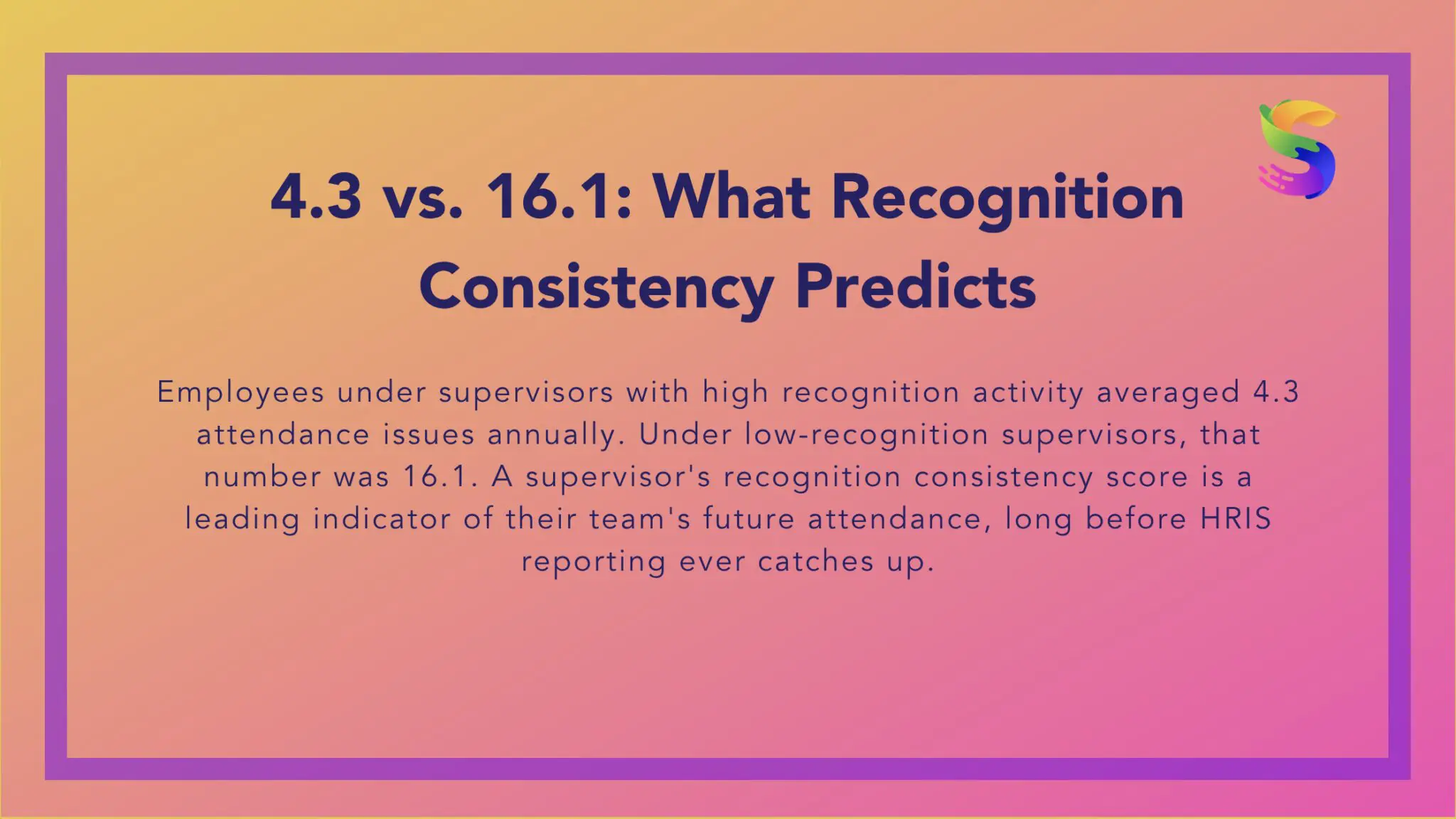
Data from CFC shows employees under supervisors with high recognition activity averaged 4.3 attendance issues annually, compared to 16.1 for employees under supervisors with low recognition activity. This is a direct, measurable link between a specific supervisor behavior and a specific operational outcome, visible well before the attendance gap would otherwise surface in HRIS reporting.
A supervisor’s recognition consistency score is, in this sense, a leading indicator of their team’s future attendance reliability. Output metrics can’t provide this kind of forward visibility because output is the lagging result, not the leading cause.
Coaching Cadence and Turnover
Buske’s regression analysis identified recognition frequency as the single strongest predictor of voluntary turnover, ahead of compensation and tenure. Coaching frequency operates through a related mechanism: consistent coaching catches the performance and engagement issues that, left unaddressed, become the disengagement that produces resignations.
A supervisor’s coaching cadence this month is a better predictor of their team’s turnover next quarter than this month’s production output is. This is precisely why behavioral metrics deserve a central place in supervisor evaluation rather than a supplementary one.
The Compounding Effect Across Metrics
These behavioral metrics aren’t independent of each other or of eventual production performance. A supervisor with strong recognition consistency, coaching frequency, and documentation discipline is building the conditions, engaged employees, clear expectations, low turnover, that make sustained production performance achievable. A supervisor weak across these behavioral metrics may post acceptable numbers in the short term while building toward the kind of disengagement and turnover that eventually erodes those same numbers.
Measuring the behavioral inputs gives organizations visibility into which supervisors are building sustainable performance and which are running on borrowed time, long before the production data would reveal the difference.
Building a Supervisor Effectiveness Scorecard
Translating these behavioral metrics into an actual evaluation framework requires combining them deliberately rather than treating any single metric as sufficient on its own.
Combine Behavioral Metrics With Outcome Metrics, Don’t Replace One With the Other
Production output still matters. The goal isn’t to stop measuring it, but to stop treating it as the only measure of supervisor effectiveness. A complete scorecard includes both the outcomes a team produces and the specific behaviors a supervisor is responsible for that predict whether those outcomes are sustainable.
Benchmark Supervisors Against Each Other, Not Just Against Targets
Comparing coaching frequency, recognition consistency, and documentation discipline across supervisors managing comparable teams surfaces variance that absolute targets alone might miss. A supervisor hitting a recognition frequency target while still being meaningfully below their peer average is still worth a development conversation, even if they’re technically meeting a baseline standard.
Use the Data Developmentally, Not Just Evaluatively
The most effective use of behavioral metrics isn’t ranking supervisors for performance reviews. It’s identifying specifically where a struggling supervisor’s behavior is falling short, so that coaching and support can be targeted rather than generic. A supervisor with weak documentation discipline needs a different conversation and different support than a supervisor with weak recognition consistency, even if both show up as “underperforming” on a generic review.
Make the Data Visible to Supervisors Themselves
Supervisors who can see their own coaching frequency, recognition consistency, and check-in cadence relative to expectations or peers have a concrete basis for self-correction that vague feedback like “be a better leader” never provides. Visibility into specific behavioral metrics turns effectiveness from an abstract evaluation into something a supervisor can actually act on day to day.
What This Requires Operationally
None of these metrics can be measured reliably through memory, self-report, or periodic manual review. Coaching frequency, recognition consistency, documentation discipline, and check-in cadence are all behaviors that happen continuously, across every shift, for every employee, which means they require systematic capture at the source to be measurable at all.
This is the same infrastructure gap that affects every category of frontline leadership measurement: the data needed to evaluate supervisor effectiveness accurately doesn’t exist unless something is capturing supervisor behavior as it happens, not reconstructing it afterward from memory or informal notes.
Organizations that build this capture into the supervisor’s actual workflow, rather than adding it as a separate reporting requirement, get behavioral data that’s both accurate and sustainable to collect. Organizations that don’t are left evaluating supervisor effectiveness the only way they can without it: by looking at production output and hoping it tells the whole story.
It doesn’t.
Ready to measure the supervisor behaviors that actually predict team performance? Explore how Secchi captures coaching frequency, recognition consistency, and documentation discipline at the source at secchi.io.
About Secchi: Secchi is the only system that captures supervisor behavior at the source. Organizations using Secchi measure frontline supervisor effectiveness through coaching frequency, recognition consistency, and documentation discipline, the leading indicators that predict turnover, attendance, and performance before they show up in production data.
Learn more at secchi.io.
Related Resources:
See how Secchi can drive positive change in your organization.
With Secchi, leaders across your entire organization have access to turn-by-turn leadership directions and actionable data that guides them on how to engage their teams through recognition, coaching, engagement, and accountability.
Want more leadership and engagement strategies straight to your inbox?
Subscribe here.