HOW TO MAKE PROGRESSIVE DISCIPLINE LEGALLY DEFENSIBLE


Most terminations that get challenged aren’t challenged because the performance problem wasn’t real.
They’re challenged because the documentation trail supporting the decision is thin, inconsistent, or doesn’t exist at all. The coaching conversations happened. The expectations were communicated. The employee genuinely had multiple opportunities to improve. None of it shows up in a record because nobody wrote it down at the time, or because it was written down for some employees and not others depending on which supervisor managed them and which shift they worked.
This is the gap where wrongful termination claims, arbitration losses, and union grievances live. Not in weak performance management. In weak documentation of legitimate performance management.
Legally defensible progressive discipline requires three things most frontline operations don’t reliably achieve: a documented record of every coaching conversation building toward the disciplinary action, consistency in how that documentation happens regardless of shift or supervisor, and language that’s structured and bias-free rather than improvised in the moment.
None of this is about making discipline harsher or more bureaucratic. It’s about making sure the discipline that’s already happening, the conversations that are already taking place, leave the trail that protects both the organization and the employee when a decision eventually gets challenged.
Why Progressive Discipline Fails Legally Even When It’s Substantively Correct

Organizations frequently assume that legal exposure in termination cases comes from making the wrong decision. More often, it comes from making the right decision without the record to prove it.
The Verbal Warning That Never Existed on Paper
Progressive discipline structures typically begin with a verbal warning, followed by a written warning, followed by escalating consequences if performance doesn’t improve. The verbal warning step is where documentation most commonly breaks down.
A supervisor has a direct conversation with an employee about a performance issue. The conversation happens. Expectations are communicated clearly. The employee understands what needs to change. None of it gets written down because it was “just a verbal warning,” and the supervisor assumes documentation starts at the written stage.
When that employee is eventually terminated after escalating issues, the verbal warning that started the process doesn’t exist in any record. The progressive discipline timeline now has a gap at the very beginning, and that gap is exactly what an employee’s legal representation will focus on. Was the employee actually given a chance to correct the behavior, or did the process effectively start at a later, harsher stage than the policy describes?
Inconsistent Application Across Shifts
Even when documentation happens, it frequently happens unevenly across an organization’s shifts. First shift supervisors, with consistent desk access and HR support available during business hours, tend to produce more thorough documentation than third shift supervisors operating without either.
This creates a specific legal vulnerability: two employees with comparable performance issues receive different documentation treatment based entirely on which shift they work, not on the severity of their conduct. If a terminated employee can show that a colleague with similar issues on a different shift received a more lenient or less consistent process, the disparity becomes evidence of unequal treatment, regardless of whether that was ever the intent.
Subjective Language That Introduces Bias Risk
Documentation written under time pressure, often after the fact and from memory, tends to rely on subjective characterizations rather than specific observed behavior. “Poor attitude” or “not a team player” are common phrases in informal discipline notes. They are also exactly the kind of language that creates bias exposure, because they describe an impression rather than a documented action.
Structured, behavior-specific documentation, “Employee left their station unattended for 45 minutes during a scheduled production run without notifying a supervisor,” is dramatically more defensible than a subjective characterization of the same incident, because it describes what happened rather than how it was interpreted.
No Record of the Organization’s Investment in Improvement
A core element of defensible progressive discipline is demonstrating that the organization gave the employee a genuine opportunity to improve before deciding to terminate. This requires showing not just that warnings were issued, but that coaching, support, and clear expectations were provided throughout the process.
Without documentation of the coaching conversations, the resources offered, and the specific feedback given between disciplinary steps, the record looks like a sequence of punishments rather than a genuine improvement process. That distinction matters significantly in arbitration and wrongful termination proceedings, where the question is often whether the employer acted in good faith to support correction before separating the employee.
What Defensible Documentation Actually Requires

Building progressive discipline that holds up under legal scrutiny requires specific documentation characteristics, not simply more documentation.
Time-Stamped Records
Every step of a progressive discipline process needs a clear timestamp establishing when it occurred. This isn’t just a formality. Timing is frequently central to legal challenges: did the employee have adequate time to respond to feedback before the next disciplinary step occurred? Was the timeline applied consistently with how similar situations were handled for other employees?
Time-stamped documentation removes ambiguity about sequencing and duration, which removes one of the most common avenues for challenging a termination’s fairness.
Structured, Not Improvised, Language
Documentation that follows a consistent structure, what behavior occurred, what expectation was communicated, what support was offered, what the employee’s response was, produces records that are both more defensible and easier to compare across cases for consistency review.
This structure also reduces the subjective and potentially biased language that creeps into discipline notes written informally and under time pressure. A structured template doesn’t allow a supervisor to write “bad attitude” because the template asks for specific observed behavior instead.
Consistency Across Every Shift and Every Supervisor
The same documentation standard needs to apply regardless of when an employee’s shift occurs or which supervisor is managing them. This is the area where most organizations have the largest unaddressed gap, not because policy is unclear, but because the tools available to supervisors create dramatically different documentation outcomes depending on shift access to desks, time, and HR support.
Achieving genuine consistency requires infrastructure that makes documentation equally achievable on every shift, not a policy memo asking supervisors to try harder.
Evidence of Coaching, Not Just Warnings
A defensible record shows the full arc of the relationship between supervisor and employee leading up to a disciplinary decision, not just the warnings themselves. Coaching conversations, recognition of improvement attempts, specific feedback on what wasn’t working, all of this builds a record showing genuine investment in correction rather than a predetermined path to termination.
Why This Is Structurally Difficult Without the Right Infrastructure
Most organizations don’t lack the intention to document well. They lack a workflow that makes thorough, consistent documentation achievable within the actual constraints of frontline supervision.
The Time Cost of Manual Documentation
Writing a structured, specific discipline record manually, particularly one that includes coaching history and behavioral detail, frequently takes 15 to 20 minutes per entry when done properly. For a supervisor managing 25 to 30 direct reports while handling active production responsibilities, this time cost is the reason documentation gets abbreviated, delayed, or skipped entirely.
The shortfall isn’t a commitment problem. It’s a workflow problem. Asking supervisors to produce more thorough documentation without changing how long that documentation takes to produce sets up the same outcome that’s already happening: documentation that’s accurate when it exists and absent when operational demands take priority.
Desk Access Disparity
Structured documentation built around desktop workflows assumes the supervisor has reliable access to a computer during or immediately after the relevant shift. First shift supervisors typically do. Supervisors managing overnight or weekend shifts frequently don’t, which means the same documentation standard produces wildly different compliance rates depending entirely on when the supervisor happens to work.
The Memory Reconstruction Problem
Even when documentation eventually happens, delays between the incident and the write-up introduce inaccuracy. A coaching conversation documented immediately afterward captures specific language and context. The same conversation documented at the end of a 12-hour shift, or worse, several days later, gets reconstructed from memory and inevitably loses precision exactly where precision matters most for legal defensibility.
Building Documentation Infrastructure That Closes the Gap
The solution to inconsistent, legally vulnerable documentation isn’t asking supervisors to do more. It’s removing the friction that makes consistent, structured documentation difficult to sustain in the first place.
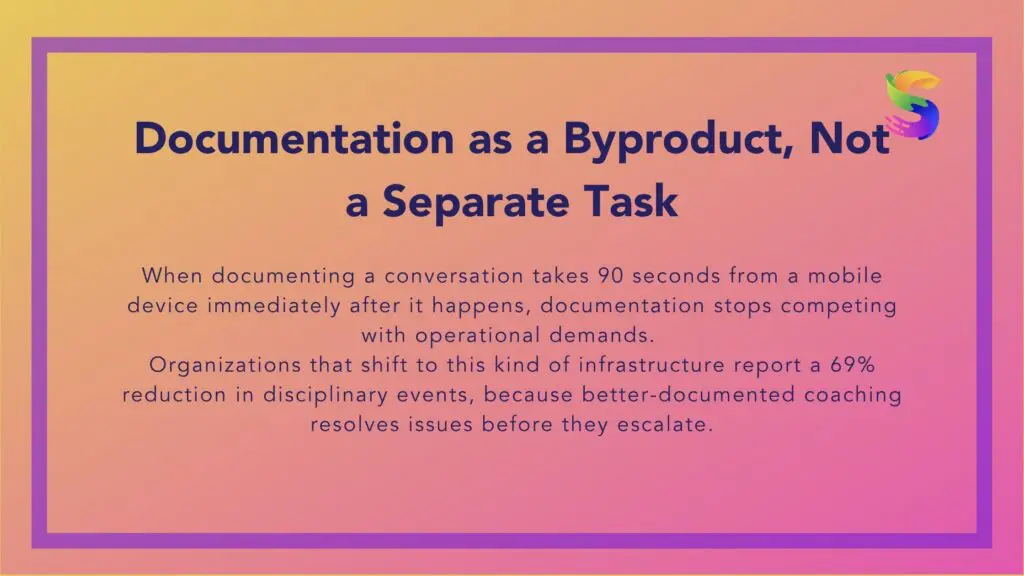
Documentation as a Byproduct of the Conversation, Not a Separate Task
When documenting a coaching conversation or disciplinary step takes 90 seconds from a mobile device immediately after the conversation happens, documentation stops competing with operational demands. It becomes part of how the conversation concludes, not a separate administrative task supervisors need to find time for later.
This single shift, from documentation as an added task to documentation as the natural conclusion of the conversation, is what makes consistency achievable at the volume frontline operations require.
Structured Prompts That Remove Subjective Language
Mobile documentation tools built around structured prompts, what behavior occurred, what was communicated, what the employee’s response was, guide supervisors toward specific, behavior-based language automatically. This produces bias-free documentation as a function of the tool’s design, not as something supervisors need to consciously remember to do under time pressure.
Equal Capability Regardless of Shift
A documentation workflow that takes 90 seconds from a phone works identically at 2 AM on third shift as it does at 10 AM on first shift. This is the infrastructure fix to the consistency problem that policy alone cannot solve. When every supervisor has the same documentation capability regardless of shift, the disparity that creates legal exposure across shift comparisons disappears.
A Complete, Connected Record
When coaching conversations, recognition events, and disciplinary steps are all captured in the same system, the resulting record shows the full relationship between supervisor and employee, not just the punitive moments. This connected history is what demonstrates genuine investment in improvement, which is frequently the deciding factor in whether a termination is viewed as defensible.
What This Looks Like in Practice
ASSA ABLOY’s experience with structured, consistent documentation illustrates the practical impact. Their arbitration-defense outcomes improved measurably once documentation became a real-time, structured byproduct of supervisor-employee interactions rather than an after-the-fact administrative requirement.
Separately, organizations that have implemented this kind of infrastructure report a 69% reduction in disciplinary events. The correct interpretation of this number isn’t that fewer problems are occurring. It’s that documentation quality improved to the point where many situations get resolved through earlier, better-documented coaching before they escalate into the kind of formal disciplinary events that create legal risk in the first place. Better documentation doesn’t just protect the organization when termination becomes necessary. It frequently prevents termination from becoming necessary at all, by making the coaching that precedes it more consistent and more effective.
The Difference Between Compliance Documentation and Defensible Documentation
It’s worth distinguishing between documentation that satisfies an internal policy checkbox and documentation that actually holds up under legal scrutiny. An organization can have high rates of “documentation completed” while still carrying significant legal exposure if that documentation is inconsistent in quality, subjective in language, or uneven across shifts.
Defensible documentation isn’t a volume metric. It’s a consistency and structure standard. The question isn’t whether a box got checked. It’s whether the resulting record, examined by an arbitrator or opposing counsel months or years later, demonstrates a fair, consistent, well-documented process regardless of which supervisor was involved or what time the relevant events occurred.
Documentation Infrastructure Is Legal Infrastructure

Organizations frequently treat documentation tools as an HR administrative convenience. For progressive discipline specifically, documentation tools are legal infrastructure. The quality and consistency of that documentation is frequently the single largest factor in whether a termination decision, however substantively justified, survives a legal challenge.
Building this infrastructure doesn’t require supervisors to become more diligent or organizations to add administrative headcount. It requires making structured, specific, time-stamped documentation the natural byproduct of supervisors doing the coaching and disciplinary conversations they’re already having, regardless of which shift those conversations happen on.
Every disciplinary action should be audit-ready. Every termination should be arbitration-protected. That standard is achievable, but only with infrastructure built for how frontline supervision actually operates, not infrastructure that assumes desk access and administrative time supervisors don’t have.
Ready to build progressive discipline documentation that’s consistent, structured, and defensible across every shift? Explore how Secchi makes audit-ready documentation a byproduct of the coaching supervisors are already doing at secchi.io.
About Secchi: Secchi is the only system that captures supervisor behavior at the source. Organizations using Secchi build legally defensible progressive discipline records through time-stamped, structured, bias-free documentation that’s consistent across every shift, without adding administrative work to the supervisor’s day.
Learn more at secchi.io.
Related Resources:
See how Secchi can drive positive change in your organization.
With Secchi, leaders across your entire organization have access to turn-by-turn leadership directions and actionable data that guides them on how to engage their teams through recognition, coaching, engagement, and accountability.
Want more leadership and engagement strategies straight to your inbox?
Subscribe here.