What is Employee Relationship Management (ERM)? The Complete Guide for Frontline Leaders


Walk into any manufacturing facility, warehouse, or food production plant, and you’ll find the same pattern: frontline supervisors drowning in paperwork, struggling to document employee performance, and managing their teams through a patchwork of spreadsheets, clipboards, and memory.
Meanwhile, their company’s HR Information System (HRIS)—the expensive platform corporate purchased to “solve everything”—sits unused on a desktop computer somewhere in the office. Why? Because it wasn’t built for them.
Traditional HRIS platforms were designed for HR departments managing white-collar employees at desks. They’re complex, time-consuming, and completely disconnected from the reality of leading hourly teams on a production floor.
This gap has created a crisis in frontline leadership. Supervisors lack the visibility, tools, and support they need to build strong relationships with their teams.
The result? Manufacturing turnover averaging 28% annually, declining engagement, and billions of dollars lost to preventable performance issues.
Enter Employee Relationship Management (ERM).
ERM represents a fundamental shift in how organizations approach frontline leadership—moving from administrative burden to relationship intelligence, from reactive firefighting to proactive team building, and from chaos to clarity.
This guide will explain what ERM is, why it matters, how it differs from traditional HR technology, and how it’s transforming frontline operations across manufacturing, food production, warehousing, and logistics.
What is Employee Relationship Management (ERM)?
Employee Relationship Management (ERM) is a strategic approach and technology platform that empowers frontline leaders to build better relationships with their teams through real-time visibility, streamlined documentation, recognition systems, and data-driven coaching insights.
Think of it this way: Customer Relationship Management (CRM) transformed how sales teams manage relationships with prospects and customers. Salespeople gained visibility into every interaction, automated tedious tasks, and made data-driven decisions that improved outcomes.
ERM does the same thing—but turns that relationship intelligence inward toward your own employees.
Instead of tracking leads through a sales funnel, ERM tracks employee engagement, performance patterns, coaching conversations, recognition moments, and attendance trends. Instead of optimizing customer lifetime value, ERM optimizes employee retention, productivity, and development.
The core premise is simple but powerful: Employees aren’t problems to be managed—they’re relationships to be built.
The Key Components of ERM
Effective ERM platforms include four essential elements:
1. Real-Time Visibility
Frontline supervisors see a complete picture of each team member—attendance history, coaching conversations, recognition received, performance trends—in one unified view. No more hunting through folders or asking HR for reports.
2. Streamlined Documentation
Performance documentation that used to take 10 steps and 15 minutes now takes 2 clicks and 30 seconds. Supervisors can document attendance, coaching, or incidents directly from their smartphones on the production floor.
3. Recognition and Engagement Tools
Built-in recognition systems allow supervisors to acknowledge great work instantly. Employees receive text messages celebrating their contributions, creating positive reinforcement loops that drive behavior change.
4. Data-Driven Coaching Insights
Rather than relying on gut feelings or waiting for annual reviews, supervisors receive actionable insights about who needs support, who’s improving, and where to focus their coaching efforts.
Why ERM Matters: The Frontline Leadership Crisis
The need for ERM becomes clear when you understand the unique challenges facing frontline leaders.
The Supervisor’s Impossible Job
Consider what we ask of frontline supervisors:
- Lead teams of 15-30 hourly employees
- Manage production quotas and quality standards
- Handle attendance issues and performance problems
- Document everything for HR and compliance
- Provide coaching and development
- Maintain safety protocols
- Do all of this with minimal training and inadequate tools
Most frontline supervisors are promoted from production roles because they were good at the technical work—not because they were trained in leadership. They’re thrust into people management with a clipboard and told to figure it out.
The result? Overwhelming administrative burden that prevents them from actually leading their teams.
The Cost of Getting It Wrong
When frontline leadership fails, the consequences ripple throughout the entire organization:
Turnover Catastrophe: Manufacturing turnover rates range from 24% to 32% annually, with production roles experiencing even higher rates of 30-38%. According to SHRM, replacement costs range from 50% to 200% of an employee’s annual salary, with the cost to replace a single employee averaging $4,000 to $4,700. For a 500-employee facility with 30% turnover, that’s potentially $705,000 to $1.4 million in annual turnover costs.
Productivity Loss: According to Gallup research, disengaged employees are 18% less productive than their engaged peers. In industries where labor represents 60-70% of operating costs, this gap devastates profitability.
Safety Incidents: Poor supervisor-employee relationships correlate directly with safety violations. When employees don’t feel seen or valued, they cut corners.
Compliance Risk: Inadequate documentation creates liability exposure. When performance issues aren’t properly documented, termination decisions become indefensible.
Recruiting Difficulty: Bad reputations spread fast. Companies known for high turnover struggle to attract quality candidates, forcing them to lower hiring standards and perpetuating the cycle.
Why Traditional Solutions Fall Short
Organizations have tried to solve these problems with:
HRIS Platforms: Built for HR departments, not frontline supervisors. Too complex, too slow, too many clicks. Supervisors avoid them.
Engagement Surveys: Annual or quarterly surveys that measure problems but don’t provide solutions. By the time you get results, your best people have already quit.
Training Programs: Leadership development that doesn’t address the tool gap. You can’t train someone to be a better leader when they’re spending 10 hours per week on administrative tasks.
Spreadsheets and Clipboards: Manual systems that create data silos, prevent real-time visibility, and guarantee inconsistency across supervisors.
None of these approaches address the fundamental issue: Frontline supervisors need relationship intelligence tools built specifically for their workflow.
ERM vs. Traditional HR Technology: Understanding the Difference
To fully grasp what makes ERM unique, let’s compare it to the other categories in the HR technology landscape.
ERM vs. HRIS (Human Resource Information Systems)
| Aspect | HRIS | ERM |
| Primary User | HR Department | Frontline Supervisors |
| Focus | Administrative compliance | Relationship building |
| Access | Desktop, office-based | Mobile, production floor |
| Complexity | High (10+ steps for tasks) | Low (2 clicks for tasks) |
| Data View | Historical records | Real-time insights |
| Purpose | Record keeping | Performance improvement |
| Adoption | Low with supervisors | High with supervisors |
The Key Distinction: HRIS platforms are record-keeping systems for HR professionals. ERM platforms are relationship-building tools for frontline leaders.
ERM vs. Engagement Platforms
Traditional engagement platforms (like CultureAmp, Glint, or Qualtrics) focus on measuring employee sentiment through surveys.
Engagement platforms tell you what is broken. They reveal low engagement scores, identify problem areas, and benchmark against industry averages.
ERM platforms give you the tools to fix what’s broken. They enable supervisors to take action—recognize great work, coach effectively, document consistently, and build stronger relationships.
Engagement platforms are diagnostic. ERM platforms are therapeutic.
ERM vs. Performance Management Systems
Performance management systems (like Lattice, 15Five, or Workday Performance) were designed for white-collar employees with annual review cycles, goal-setting frameworks, and continuous feedback.
These systems assume:
- Employees have desk jobs and computer access
- Performance discussions happen in scheduled 1-on-1 meetings
- Goals are set quarterly and tracked digitally
- Feedback is primarily written and asynchronous
Frontline reality is completely different:
- Employees work on production floors without desk access
- Performance conversations happen in real-time during shifts
- Goals are daily or weekly (production quotas, attendance, quality)
- Feedback needs to be immediate and often verbal
ERM is purpose-built for this reality.
The Four Pillars of Effective ERM
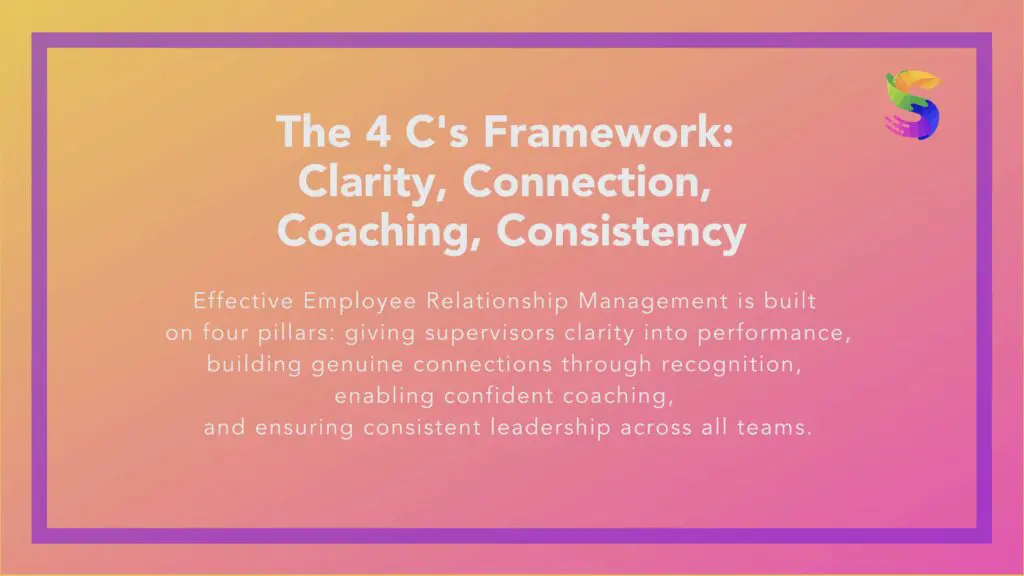
At Secchi, we’ve identified four foundational pillars that define excellent Employee Relationship Management:
1. Clarity: See Your Team Clearly
The Problem: Supervisors make decisions based on incomplete information, gut feelings, or whoever’s loudest.
The ERM Solution: Complete 360° visibility into every team member’s performance, attendance patterns, coaching history, and recognition moments—all in one unified view accessible from a smartphone.
Real-World Impact: When supervisors have clarity, they can identify issues before they become crises, recognize improvement trends, and make fair, data-backed decisions.
Example: A supervisor notices an employee’s attendance has been perfect for 30 days after a rocky period. With ERM, they can instantly recognize that improvement with a text message, reinforcing the positive behavior change.
2. Connection: Build Real Relationships
The Problem: Hourly employees often feel invisible. Their supervisors are too busy with paperwork to notice their contributions.
The ERM Solution: Frictionless recognition systems that allow supervisors to acknowledge great work in seconds. Employees receive immediate positive reinforcement via text message, creating emotional connection and loyalty.
Real-World Impact: Recognition frequency directly correlates with retention. Employees who feel seen and valued stay longer and perform better.
Example: A production worker stays late to help train a new team member. Their supervisor sends recognition through ERM, taking 15 seconds. The employee receives a text: “Thanks for helping train Sarah today. Your mentorship makes this team stronger.” That moment of being seen transforms the relationship.
3. Coaching: Guide with Confidence
The Problem: Supervisors avoid difficult conversations because documentation is painful and they lack frameworks for effective feedback.
The ERM Solution: Guided coaching templates, conversation scripts, and instant documentation that makes supervisors more confident and consistent in their leadership.
Real-World Impact: Documented coaching conversations prevent minor issues from becoming termination events. They also protect organizations from wrongful termination claims.
Example: An attendance issue that previously required 15 minutes of paperwork across three systems now takes 30 seconds to document. The supervisor can focus on the actual conversation rather than dreading the administrative burden.
4. Consistency: Make Leadership Predictable
The Problem: Leadership quality varies wildly across supervisors. Some are excellent, others wing it. Employees experience unfair treatment depending on who their supervisor is.
The ERM Solution: Standardized workflows and frameworks that ensure every supervisor follows best practices, regardless of experience level.
Real-World Impact: Consistent leadership creates trust. When employees know what to expect, they feel safer, perform better, and stay longer.
Example: A new supervisor promoted from production uses the same coaching frameworks and recognition systems as the 20-year veteran supervisor. Both teams experience consistent, quality leadership.
The Business Case for ERM: ROI That Matters
The question every business leader asks: “What’s the return on investment?”
The data from organizations using ERM is compelling:
Turnover Reduction
Average Impact: Secchi customers achieve 71% reduction in turnover within 90 days
Financial Value: For a 500-employee facility with 28% annual turnover and $4,500 replacement costs per employee (SHRM average), reducing turnover by 60% saves $378,000 annually.
Why It Works: Employees stay when they feel seen, recognized, and fairly treated. ERM makes this happen at scale.
Productivity Gains
Average Impact: Secchi customers see 23% increase in productivity within 90 days
Financial Value: In labor-intensive industries where personnel costs represent 60-70% of operating expenses, a 20% productivity gain directly impacts bottom-line profitability.
Why It Works: Clear expectations, consistent feedback, and recognition for great work create a performance culture.
Administrative Time Savings
Average Impact: 50% reduction in supervisor administrative burden
Financial Value: If 20 supervisors each save 5 hours per week on documentation, that’s 100 hours weekly—5,200 hours annually—redirected to actual leadership.
Why It Works: 10 steps reduced to 2 clicks multiplied across thousands of interactions creates massive efficiency gains. Try our cost savings calculator to see your potential impact.
Compliance Protection
Average Impact: Reduction in wrongful termination claims and EEOC complaints
Financial Value: Wrongful termination settlements can easily exceed $40,000. Proper documentation prevents these entirely.
Why It Works: Consistent, documented coaching conversations create defensible decision trails.
Safety Improvements
Average Impact: Correlation between strong supervisor relationships and reduced safety incidents
Financial Value: Workplace injuries are costly in both direct and indirect expenses.
Why It Works: Employees who feel valued by supervisors are more likely to follow safety protocols and speak up about hazards.
How to Evaluate ERM Solutions: A Buyer’s Guide
Not all ERM platforms are created equal. If you’re considering implementing ERM in your organization, here are the critical evaluation criteria:
1. Mobile-First Design
Your supervisors are on production floors, not at desks. The platform must be built for smartphones first, desktop second. If it requires computer access for core functions, it won’t get used.
Questions to Ask:
- Can supervisors document performance in 2 clicks from their phone?
- Does the mobile experience feel native, or is it just a responsive website?
- Can employees receive recognition via text message?
2. Simplicity Over Features
Complex platforms with 47 features sound impressive in demos but get abandoned in practice. Frontline supervisors need tools that are intuitive, fast, and require zero training.
Questions to Ask:
- Can a new supervisor use this effectively on day one without training?
- How many clicks does it take to complete the most common tasks?
- Is the interface clean and uncluttered?
3. Real-Time Data and Insights
Historical reports are useful for HR. Supervisors need real-time visibility to make in-the-moment decisions.
Questions to Ask:
- Do supervisors see live data, or are reports generated overnight?
- Can supervisors access an employee’s complete performance history instantly?
- Does the platform provide proactive alerts about issues?
4. Purpose-Built for Frontline
Generic performance management tools adapted for hourly workers always fall short. Look for platforms designed specifically for frontline operations.
Questions to Ask:
- Was this built for supervisors managing hourly employees, or adapted from corporate tools?
- Do the workflows match how frontline leadership actually happens?
- Are the use cases relevant to your industry?
5. Implementation Speed
Complex rollouts that take 6 months to implement never gain traction. Look for platforms that can be deployed in weeks, not quarters.
Questions to Ask:
- What’s the typical time from contract to full deployment?
- How much internal IT support is required?
- What does the training process look like?
6. Integration Capabilities
Your ERM platform should complement your HRIS, not replace it. Look for seamless integrations that eliminate duplicate data entry.
Questions to Ask:
- What HRIS platforms does this integrate with?
- Is the integration bidirectional or one-way?
- How often does data sync?
Getting Started with ERM: A Practical Roadmap
Ready to implement ERM in your organization? Here’s a proven approach:
Phase 1: 90-Day Pilot Program
Start with one facility, one shift, or one department. Prove the concept before rolling out enterprise-wide.
Goals:
- Demonstrate measurable improvement in 90 days
- Build case studies and internal champions
- Identify implementation best practices
- Gather feedback for optimization
Success Metrics:
- Supervisor adoption rate (target: 90%+)
- Documentation completion rate
- Employee recognition frequency
- Early indicators of turnover improvement
Book a pilot consultation to discuss your specific goals and timeline.
Phase 2: Expansion (Days 90-180)
Scale to additional facilities or departments based on pilot learnings.
Goals:
- Standardize rollout playbook
- Train internal champions
- Create feedback loops
- Build momentum
Phase 3: Optimization (180+ Days)
Refine workflows, integrate deeper with existing systems, and leverage advanced features.
Goals:
- Analyze performance trends
- Identify top-performing supervisors and replicate their approaches
- Customize for specific operational needs
- Measure long-term ROI
Common Objections and How to Address Them
When introducing ERM to your organization, you’ll encounter predictable resistance. Here’s how to handle it:
“Our HRIS already does this.”
The Reality: It doesn’t. HRIS platforms track records; they don’t build relationships. If your supervisors aren’t using the HRIS consistently, that’s proof it doesn’t work for them.
The Response: “Let’s look at supervisor adoption rates. If 80% of our supervisors avoid the HRIS, we have a tool gap, not a training gap.”
“This is just another tool to learn.”
The Reality: ERM reduces tool complexity by consolidating workflows into one simple platform.
The Response: “Actually, this replaces spreadsheets, clipboards, and unused HRIS modules. We’re going from five tools to one.”
“Our supervisors won’t use it.”
The Reality: Supervisors avoid complex tools. They embrace tools that make their jobs easier.
The Response: “Let’s pilot with your most skeptical supervisor. If we can’t show them value in 30 days, we’ll walk away.”
“We don’t have time to implement something new.”
The Reality: You don’t have time NOT to. Turnover and administrative burden are costing you millions annually.
The Response: “The pilot takes two weeks to implement and saves each supervisor 5 hours per week. That’s a positive ROI in week three.”
The Future of Frontline Leadership
Employee Relationship Management isn’t just a technology category—it’s a fundamental shift in how organizations think about frontline leadership.
For too long, we’ve treated hourly employees as interchangeable resources and their supervisors as foremen focused solely on production output. ERM recognizes what should have been obvious all along: The quality of supervisor-employee relationships directly determines operational outcomes.
Organizations that embrace this shift—that invest in giving their frontline leaders the tools, visibility, and support they need to build better relationships—will win the war for talent, outperform competitors on productivity, and create sustainable operational excellence.
The question isn’t whether ERM will become standard in frontline operations. The question is whether your organization will lead this transformation or scramble to catch up in three years.
Take the Next Step
Ready to see what Employee Relationship Management can do for your frontline teams?
Start with a 90-day pilot. We’ll help you choose one facility or department, implement in two weeks, and demonstrate measurable results within 90 days. If you don’t see clear value, walk away with no hard feelings.
Schedule a consultation call to discuss your specific challenges and explore how ERM can transform your frontline operations.
Download case studies to see how organizations like yours achieved 71% turnover reduction and 23% productivity gains.
Try our ROI calculator to estimate your potential savings from reduced turnover and improved productivity.
Your best supervisors are waiting for better tools. Your best employees are deciding whether to stay or leave. And your competitors are reading this same article.
The time to act is now.
About Secchi: Secchi is the leading Employee Relationship Management platform purpose-built for frontline leaders. Our customers achieve an average 71% reduction in turnover, 50% improvement in attendance, and 23% increase in productivity—all within 90 days. Learn more at secchi.io.
Related Resources:
See how Secchi can drive positive change in your organization.
With Secchi, leaders across your entire organization have access to turn-by-turn leadership directions and actionable data that guides them on how to engage their teams through recognition, coaching, engagement, and accountability.
Want more leadership and engagement strategies straight to your inbox?
Subscribe here.