FROM SPREADSHEETS TO SYSTEMS: MODERN ATTENDANCE TRACKING FOR SUPERVISORS


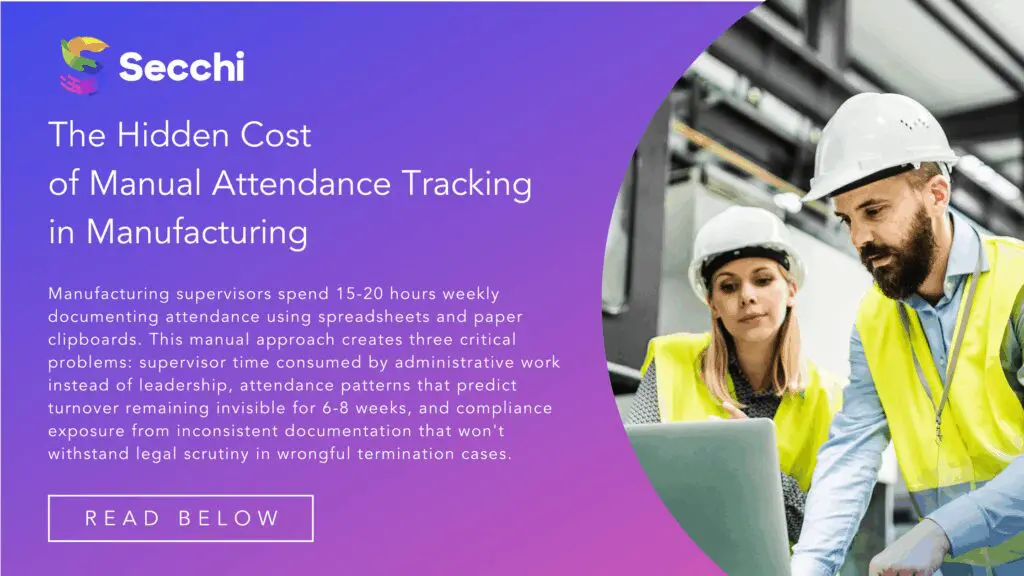
Modern Attendance Tracking for Frontline Supervisors
Frontline supervisors spend 15-20 hours weekly on attendance documentation using tools designed 30 years ago.
Spreadsheets. Paper clipboards. Desktop HRIS systems requiring office access. Manual data compilation for weekly reports.
The inefficiency is obvious. But the hidden costs run deeper:
- Attendance patterns that predict turnover go unnoticed for 6-8 weeks
- Documentation delays create legal exposure in wrongful termination cases
- Supervisors spend time on paperwork instead of coaching and leadership
- Compliance inconsistencies expose organizations to discrimination claims
Most facilities accept these costs as “just how attendance tracking works” without recognizing that purpose-built alternatives exist modern systems designed for frontline operations rather than office environments.
This guide examines why traditional attendance tracking fails frontline supervisors, what modern systems enable, and how organizations achieve measurable operational improvements through better attendance infrastructure.
The Hidden Cost of Manual Attendance Tracking
Before implementing solutions, understand the actual cost of your current approach.
Supervisor Time Consumption
The average frontline supervisor manages 25-30 hourly employees across attendance documentation, performance tracking, coaching conversations, and operational demands.
Manual attendance tracking consumes 15-20 hours weekly through:
- Walking to offices to access desktop HRIS systems
- Navigating multi-step documentation workflows
- Compiling spreadsheet data for weekly reports
- Reconstructing incidents from memory hours or days after occurrence
- Responding to HR requests for attendance verification
This represents 40-50% of a supervisor’s work week spent on administrative tasks rather than leadership, coaching, or operational problem-solving.
The opportunity cost: organizations implementing modern attendance tracking reclaim 95% of this time, enabling supervisors to focus on activities that directly impact retention, quality, and productivity.
Legal and Compliance Exposure
Attendance documentation serves critical compliance functions. Inadequate or inconsistent records create legal vulnerability in:
- Wrongful termination claims (burden of proof falls on employer)
- Unemployment disputes (attendance records determine eligibility)
- Workers’ compensation cases (attendance patterns provide context)
- FMLA and ADA compliance (tracking leave patterns and accommodation requests)
Manual systems create documentation gaps. Supervisors delay recording incidents due to system friction. Memory fades. Details become approximate. Timestamps aren’t captured accurately.
When legal challenges arise, inaccurate records fail to provide the clear, contemporaneous documentation required for defense. The cost: wrongful termination settlements in frontline environments average $40,000-$75,000, not including legal fees.
Modern attendance systems eliminate documentation gaps through real-time mobile capture, automatic timestamping, and consistent formatting that creates legally defensible records.
The Invisible Turnover Cost
Perhaps the most expensive consequence of manual attendance tracking: the inability to detect disengagement patterns early enough to intervene.
Attendance deterioration typically precedes voluntary turnover by 6-10 weeks. An employee who was reliably punctual begins arriving 5-10 minutes late. Friday absences increase. Early departures become more frequent.
These patterns signal disengagement, job search activity, or personal circumstances affecting work commitment. Early coaching conversations can address issues before resignations occur.
Manual tracking renders these patterns invisible until they become obvious by which point, intervention opportunities have passed. Supervisors cannot track subtle attendance shifts across 25-30 employees using memory or weekly spreadsheet reviews.
Real-time attendance systems surface these patterns within days, generating automatic alerts that prompt coaching conversations in Week 2 rather than disciplinary action in Week 10.
The financial impact: frontline operations that implement proactive pattern detection achieve 10-15% turnover reduction. For a 200-person facility with $10,000 per-person turnover costs, this represents $200,000-$300,000 annual savings.
Why Traditional Attendance Tracking Fails Frontline Supervisors
Understanding system limitations explains why manual processes persist despite obvious inefficiencies.
Desktop-Centric Design
Traditional HRIS platforms were built for office environments where managers sit at desks with continuous computer access.
Frontline supervisors operate differently. They spend 80-90% of their day on production floors, in warehouses, or in field locations. Walking to an office, logging into a desktop system, and navigating multi-step attendance documentation workflows requires 8-12 minutes per incident.
When supervisors observe a tardiness at 7:05am, they face a choice: immediately document it (requiring 10+ minutes away from floor operations) or delay documentation until later (risking forgotten details and lost accuracy).
Most choose delayed documentation. The result: incomplete records, inaccurate timestamps, and compliance exposure.
Mobile-first systems designed for frontline operations eliminate this friction. Documentation occurs in 10-15 seconds from the floor without requiring office access or desktop systems.
No Pattern Detection Capability
Spreadsheets store data but don’t analyze it. Supervisors managing 25-30 employees cannot realistically track attendance patterns manually while handling operational demands.
Why patterns stay invisible:
Supervisors manage 25-30 employees while running production. They cannot possibly track attendance patterns manually across their entire team while handling equipment issues, quality problems, safety concerns, and operational demands.
They notice the extremes: perfect attendance and chronic absenteeism. The subtle shifts where an employee who goes from zero tardiness to 2-3 instances monthly, or whose absence rate increases from 2% to 6% that go undetected until enough incidents accumulate to trigger formal discipline.
By the time manual systems surface the pattern, you’ve missed the 6-8 week intervention window. The coaching conversation that should have happened in Week 2 (when the pattern first emerged) happens in Week 10 (when progressive discipline requirements force attention). Often, the employee has already accepted another job offer.
The spreadsheet compilation problem:
Even when attendance data exists, extracting actionable insights requires manual analysis that rarely happens with sufficient frequency.
HR might review attendance reports monthly or quarterly, identifying employees with concerning patterns. But by the time this analysis reaches supervisors and prompts intervention, additional weeks have passed. The employee flagged in January’s report might resign in February before coaching occurs.
Real-time pattern detection requires real-time data systems. Manual processes create information lags that prevent proactive intervention.
What Modern Attendance Tracking Enables
Purpose-built attendance tracking systems that are designed specifically for frontline operations rather than adapted from office-worker HR platforms to transform both the supervisor experience and the operational outcomes.
Real-Time Mobile Documentation
Modern systems enable supervisors to document attendance issues in 10-30 seconds from mobile devices on the production floor:
The workflow:
- Supervisor observes tardiness at 7:05am
- Pulls out phone (already logged in via biometric authentication)
- Selects employee from team list
- Taps attendance issue type (tardy, absent, early departure)
- System auto-captures timestamp and location
- Optional: Adds brief note if context relevant
- Done – supervisor returns to floor operations
Total time: 10-15 seconds.
No walking to offices.
No desktop login.
No form navigation.
No delayed documentation.
The efficiency gain is dramatic: 10 seconds versus 8-12 minutes represents 98% time reduction. Multiply across daily attendance issues and the supervisor time reclaimed becomes substantial. 15-20 hours weekly across a typical facility.
But the greater benefit isn’t just efficiency but it’s accuracy and completeness.
When documentation takes 10 seconds, supervisors do it immediately. Timestamps are precise because they’re captured automatically when the incident occurs. Details are accurate because memory is fresh. Compliance gaps disappear because friction is eliminated.
Organizations implementing mobile attendance documentation report 95-98% documentation completion rates versus 60-75% with traditional systems.
Automatic Pattern Detection and Alerts
Modern systems analyze attendance data continuously, surfacing patterns supervisors cannot track manually across 25-30 employees.
Examples of automatic pattern detection:
- “Employee attendance reliability declined 15% over the past 4 weeks”
- “This employee has had 3 Monday absences in the past 5 weeks”
- “Tardiness frequency increased from 1/month to 4/month over the past quarter”
- “This employee shifted from consistently punctual to frequently late over 6 weeks”
These patterns signal disengagement, job search activity, or personal circumstances affecting work commitment. Automatic alerts prompt coaching conversations in Week 2-3 rather than disciplinary action in Week 8-10.
The intervention timing difference is critical. Early coaching conversations often uncover and resolve underlying issues like transportation challenges, family situations, schedule conflicts before resignations occur.
Organizations using real-time pattern detection report 18-25 days earlier intervention than facilities relying on manual attendance review. This window often represents the difference between retention and resignation.
Progressive Discipline Automation
Manual progressive discipline tracking creates inconsistency that undermines both operational fairness and legal defensibility.
The typical problem:
Supervisor A consistently documents first-offense verbal warnings. Supervisor B tends to let first offenses slide, beginning formal discipline at second offense. Supervisor C documents sporadically based on workload and memory.
This inconsistency creates fairness issues (“Why did I get written up when others don’t?”) and legal exposure (discriminatory application of policies).
Modern systems automate progressive discipline tracking:
- System recognizes the attendance issue type and employee’s discipline history
- Automatically recommends appropriate disciplinary step based on policy
- Generates pre-filled discipline forms with policy language
- Tracks timelines for progressive discipline escalation
- Maintains complete audit trail of all actions
Consistency improves dramatically. Supervisors follow identical processes. Documentation is complete. Policy application becomes fair and legally defensible.
Case study: Hispanic Cheese Makers achieved 100% progressive discipline consistency across 8 supervisors managing 180 employees after implementing automated tracking.
Analytics for Operational Intelligence
Beyond individual employee tracking, modern systems provide facility-level analytics that inform operational decisions:
Attendance pattern insights:
- Which shifts have highest absenteeism?
- Do specific days (Mondays, Fridays) show elevated absence rates?
- How do attendance patterns correlate with production issues or quality problems?
- Which teams have best/worst attendance reliability?
This intelligence enables targeted interventions: shift incentives where absenteeism is highest, schedule adjustments to accommodate patterns, supervisor coaching on teams with poor attendance.
Organizations using attendance analytics report 8-15% attendance improvement through data-driven interventions.
Implementation: Transitioning from Manual to Modern Systems
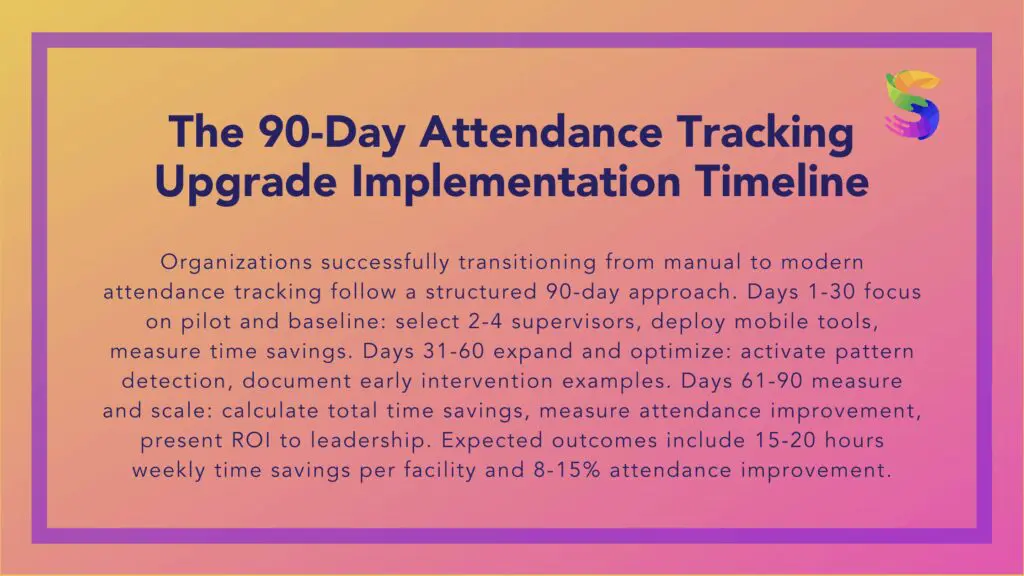
Successful attendance tracking modernization requires structured approach addressing technology, process, and change management.
Phase 1: Current State Assessment (Week 1-2)
Before implementing solutions, quantify the problems you’re solving:
Measure:
- Average supervisor time spent on attendance documentation weekly
- Attendance documentation completion rates (what percentage of incidents are actually recorded?)
- Time lag between incidents and documentation (same day? next day? weekly batch?)
- Progressive discipline consistency across supervisors
- Time from pattern emergence to supervisor intervention
This baseline enables ROI measurement and identifies specific pain points the new system must address.
Audit existing policies:
Review progressive discipline policies, attendance point systems, and escalation procedures. Ensure policies are current, legally compliant, and appropriate for your operations before automating their enforcement.
Phase 2: System Selection and Configuration (Week 3-4)
Select attendance tracking systems designed for frontline operations rather than office environments.
Critical selection criteria:
- Mobile-first design: Can supervisors document incidents in under 30 seconds from phones?
- Offline capability: Does system function when network connectivity is limited?
- Pattern detection: Does system analyze data and generate proactive alerts?
- Progressive discipline automation: Does system guide supervisors through appropriate actions?
- Integration capability: Does system connect with existing HRIS/payroll/timekeeping platforms?
- Customization: Can system adapt to your specific policies and workflows?
Configure the system to match your policies: define attendance incident types, set up progressive discipline workflows, establish pattern detection rules, configure alert thresholds.
Phase 3: Pilot Implementation (Week 5-8)
Begin with 2-4 supervisors rather than facility-wide rollout. This approach identifies implementation issues before broad deployment.
Pilot success factors:
- Select supervisors who are both tech-comfortable and operationally credible (peer influence matters)
- Provide intensive support during first 2 weeks (daily check-ins, real-time assistance)
- Measure specific outcomes: documentation completion rates, time spent, pattern detection effectiveness
- Gather feedback on system friction points and process improvements
- Document “wins” (early interventions, time savings, compliance improvements) for broader communication
Successful pilots generate internal advocates who help drive broader adoption.
Phase 4: Facility-Wide Rollout (Week 9-12)
With pilot learnings incorporated, expand to all supervisors.
Rollout approach:
- Training: 60-90 minute hands-on sessions focusing on most common workflows
- Supervisor champions: Pilot participants provide peer support and credibility
- Daily monitoring: Track adoption metrics (login frequency, documentation rates) and intervene quickly on low usage
- Quick wins communication: Share early intervention successes and time savings examples across supervisor team
The first 3 weeks post-rollout are critical. Supervisor habits form during this period. Intensive support and monitoring during this window determines long-term adoption.
Phase 5: Measurement and Optimization (Week 13+)
Track outcomes against baseline metrics established in Phase 1:
Key metrics:
- Supervisor time spent on attendance documentation (target: 95% reduction)
- Documentation completion rates (target: 95%+)
- Time from incident to documentation (target: same-day for 98%+)
- Progressive discipline consistency (target: 100% policy compliance)
- Time from pattern emergence to intervention (target: under 2 weeks)
- Operational impact: attendance reliability improvement, turnover reduction
Share results broadly. Quantified improvements reinforce adoption and justify continued investment.
Measuring Success: Key Performance Indicators
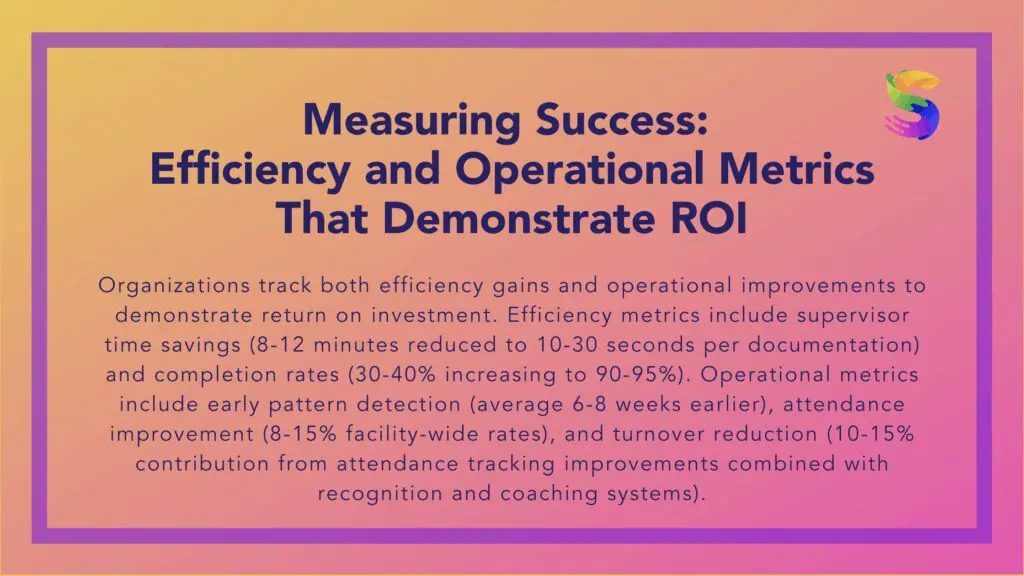
Modern attendance tracking delivers measurable outcomes across efficiency, compliance, and operational performance.
Efficiency Metrics
Supervisor time savings:
Organizations implementing mobile attendance documentation report 95-98% reduction in supervisor administrative burden:
- Traditional documentation: 8-12 minutes per incident
- Modern mobile documentation: 10-15 seconds per incident
- Time reclaimed: 15-20 hours weekly per supervisor
This reclaimed time enables coaching, recognition, problem-solving, and leadership activities that directly impact retention and performance.
Documentation completeness:
Manual systems achieve 60-75% documentation completion. Modern mobile systems achieve 95-98% completion through friction elimination.
Complete documentation provides the data foundation for pattern detection, progressive discipline consistency, and legal defensibility.
Compliance Metrics
Progressive discipline consistency:
Modern systems enforce consistent policy application. Organizations report 95-100% progressive discipline consistency versus 40-60% with manual tracking.
Consistency improves both operational fairness (employees perceive equitable treatment) and legal defensibility (policies applied without discrimination).
Documentation quality:
Timestamp accuracy, completeness, and contemporaneous recording all improve dramatically. When legal challenges arise, modern systems provide clear, defensible records that protect organizations from wrongful termination liability.
Operational Impact Metrics
Early intervention effectiveness:
Organizations using real-time pattern detection report 18-25 days earlier intervention than manual systems. This window represents the difference between coaching conversations that prevent resignations versus exit interviews that document reasons after departure.
Case study: Wabash Castings reduced voluntary turnover by 23% through early pattern detection and coaching interventions enabled by modern attendance tracking.
Attendance reliability improvement:
When supervisors can detect and address patterns proactively, attendance reliability improves. Organizations report 8-15% attendance improvement through targeted interventions informed by analytics.
Better attendance creates operational stability: consistent staffing, reduced overtime costs, fewer coverage gaps, improved quality from experienced team members.
Turnover reduction:
The retention impact of modern attendance tracking operates through multiple mechanisms:
- Early intervention prevents resignations from employees experiencing temporary challenges
- Consistent progressive discipline creates fairness perception that improves engagement
- Supervisor time reclaimed enables relationship-building and coaching that drives retention
- Pattern detection identifies disengagement early enough for corrective action
Combined effect: organizations implementing modern attendance tracking alongside broader Employee Relationship Management capabilities achieve 10-15% turnover reduction.
The Strategic Context: Why Attendance Tracking Matters Beyond Efficiency
Modern attendance tracking isn’t just operational improvement – it’s infrastructure enabling supervisor effectiveness that drives competitive advantage.
The Frontline Supervisor Capacity Problem
Frontline supervisors are the most leveraged leadership position in operations. Their effectiveness scales across 25-30 direct reports, directly impacting retention, productivity, quality, and safety for entire teams.
Yet these critical leaders operate with the weakest infrastructure support.
Desktop-centric HRIS platforms designed for office managers don’t serve frontline supervisors managing floor operations. Manual spreadsheets and paper clipboards consume hours weekly on administrative work that could be spent coaching.
The result: supervisor capacity is consumed by administrative friction rather than deployed toward high-value leadership activities.
Research from Gallup shows disengaged employees are 18% less productive than engaged peers. Frontline supervisors drive engagement through recognition, coaching, and relationship-building – activities they cannot prioritize when buried in attendance paperwork.
Organizations implementing modern attendance systems don’t just improve efficiency – they reclaim supervisor capacity for leadership.
The Data Visibility Gap
Traditional systems provide backward-looking reports that describe what already happened. They don’t enable proactive intervention.
Attendance reports show last month’s absenteeism rate. Performance reviews happen annually. Turnover data is compiled quarterly. All lagging indicators that confirm problems after opportunities to intervene have passed.
Modern attendance tracking provides real-time leading indicators:
- Attendance pattern changes: “This employee’s attendance declined 30% over the past 3 weeks – check in today.”
- Recognition gaps: “This employee hasn’t been recognized in 45 days while peers average 8 recognition moments.”
- Coaching frequency: “You haven’t had a documented conversation with this employee in 6 weeks.”
These aren’t just data points. They’re actionable insights that tell supervisors exactly what to do next.
Organizations using real-time engagement data intervene an average of 18 days earlier than those using traditional reporting. That’s 18 days to address issues before they become resignations.
The Competitive Dynamic
Manual systems render this intelligence invisible until problems become obvious – by which point, intervention opportunities have passed.
Modern attendance tracking doesn’t just reduce administrative burden (though 15-20 hours reclaimed weekly per supervisor is substantial). It transforms attendance data from compliance paperwork into operational intelligence enabling proactive leadership.
Organizations implementing modern attendance systems achieve 8-15% attendance improvement and 10-15% turnover reduction. These gains compound: better attendance improves production consistency, reduces overtime costs, and decreases quality issues from coverage gaps. Lower turnover reduces recruitment costs, training burden, and knowledge loss.
Competitors operating with spreadsheets and clipboards cannot match these outcomes through harder work or better training. The tools create operational advantages that compound over time.
The implementation decision:
Most facilities continue manual attendance tracking because “that’s how we’ve always done it” rather than because they’ve evaluated alternatives and chosen spreadsheets deliberately.
Modern systems typically implement in 60-90 days with ROI timeframes of 90-120 days. The investment is minimal compared to annual costs of manual processes (supervisor time + compliance risk + missed intervention opportunities).
The question isn’t whether modern attendance tracking improves operations with data from dozens of implementations confirms measurable gains. The question is whether your organization will be among early adopters building competitive advantage, or among late adopters eventually forced to catch up.
From spreadsheets to systems isn’t about technology for technology’s sake. It’s about giving supervisors tools that enable them to see patterns, intervene proactively, and build relationships rather than drowning in administrative work.
Your supervisors want to lead effectively. Manual attendance tracking prevents them from doing so. Modern systems remove that barrier.
The tools exist. The ROI is proven. The question is whether leadership will acknowledge that frontline attendance tracking deserves infrastructure as sophisticated as other operational systems.
Frontline operations evolved from paper production logs to real-time monitoring systems because data visibility drives operational excellence. Workforce management deserves the same evolution – from spreadsheets to systems that enable the proactive leadership your supervisors want to provide.
Getting Started
Organizations ready to modernize attendance tracking should:
- Audit current state: Calculate actual supervisor time spent on attendance documentation, completion rates, and intervention timing
- Define success metrics: Establish baselines for efficiency, compliance, and operational impact measurements
- Pilot before scaling: Start with 2-4 supervisors to validate time savings and identify implementation issues
- Measure and iterate: Track metrics weekly during first 90 days, adjusting workflows based on supervisor feedback
- Scale deliberately: Expand facility-by-facility or shift-by-shift rather than enterprise-wide simultaneous rollout
The transition from manual to modern attendance tracking isn’t just operational improvement. It’s infrastructure investment enabling supervisor effectiveness, employee engagement, and retention outcomes that create lasting competitive advantage.
Your supervisors are ready. Your employees deserve it.
The question is whether your organization will lead the transition or eventually follow.
Ready to explore modern attendance tracking for your operation?
Learn more about purpose-built systems designed for frontline teams at secchi.io.
About Secchi: Secchi is an Employee Relationship Management platform designed for frontline teams. Organizations using Secchi achieve 95% reduction in supervisor administrative burden through mobile-first attendance tracking, real-time pattern detection, and automated progressive discipline guidance. Learn more at secchi.io.
Related Resources:
See how Secchi can drive positive change in your organization.
With Secchi, leaders across your entire organization have access to turn-by-turn leadership directions and actionable data that guides them on how to engage their teams through recognition, coaching, engagement, and accountability.
Want more leadership and engagement strategies straight to your inbox?
Subscribe here.