SQF Edition 10 Compliance Made Simple: How ERM Helps Food Manufacturers Meet New Requirements


Introduction
If you’re a food manufacturer, you’ve likely heard about SQF Edition 10—and the significant changes it brings to food safety compliance requirements.
Among the most talked-about updates is an elevated focus area that catches many food manufacturers off guard: food safety culture and employee engagement.
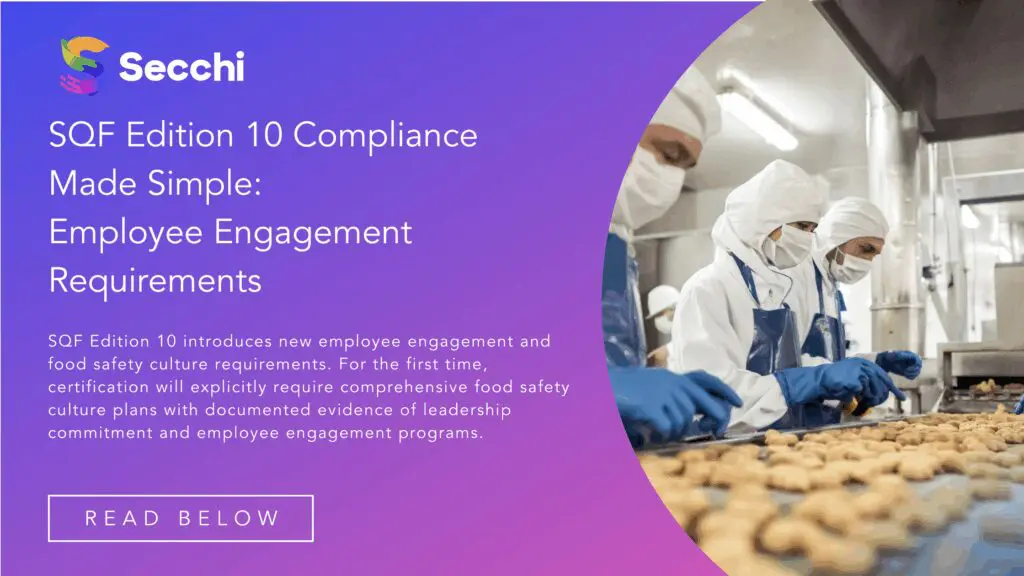
For the first time, SQF certification will explicitly require comprehensive food safety culture plans with documented evidence of leadership commitment, employee engagement programs, and tangible metrics tied to continuous improvement. This isn’t a soft suggestion—it’s an auditable core requirement that will directly impact your ability to maintain certification.
SQF Edition 10 is scheduled for release in July 2025, with implementation for auditing set for the first half of 2026. While that might seem like plenty of time, many food production facilities are scrambling to understand what’s required and how to implement compliant systems without adding overwhelming administrative burden to their already-stretched operations teams.
Here’s the good news: The same technology that helps frontline leaders build better relationships with their teams also creates audit-ready documentation that satisfies SQF Edition 10 requirements.
This guide will explain what SQF Edition 10 requires, why food safety culture became a core compliance issue, what auditors will look for, and how modern Employee Relationship Management (ERM) platforms make compliance both simple and genuinely valuable for your operation.
What is SQF Edition 10 and Why Does It Matter?
The Safe Quality Food (SQF) Program is one of the world’s most rigorous food safety certification schemes, recognized by the Global Food Safety Initiative (GFSI). Retailers like Walmart, Costco, and major grocery chains require their suppliers to maintain SQF certification.
SQF Edition 10 represents the most significant update to the standard in years, aligning with GFSI Benchmarking Requirements (2024) and introducing new requirements across multiple areas:
- Enhanced food fraud prevention and cybersecurity within food defense
- Comprehensive food safety culture plans (core requirement, not optional)
- Strengthened change management protocols
- More prescriptive employee competency and training requirements
- Potential shift to Pass/Fail audit scoring system
- Reintroduction of SQF pre-audits
For food manufacturers, maintaining SQF certification isn’t optional—it’s a fundamental requirement for market access. Loss of certification can mean immediate loss of major customer contracts and catastrophic revenue impact.
Understanding the SQF Edition 10 Food Safety Culture Requirement
What the Standard Actually Says
SQF Edition 10 makes food safety culture a core, non-optional requirement. The standard requires facilities to:
1. Establish Documented Food Safety Culture Plans Organizations must create comprehensive plans that include:
- Defined objectives aligned with both SQF expectations and internal goals
- Leadership accountability for setting the tone and resourcing the program
- Employee awareness and participation through regular communication and feedback loops
- Culture-related metrics (audit preparedness, issue response time, training retention)
- Continuous improvement through review of performance metrics
- Formal documentation of initiatives, outcomes, and reviews
2. Demonstrate Employee Engagement and Competency The standard emphasizes competency-based training rather than just basic instruction:
- Facilities must demonstrate that employees understand and can apply what they’ve learned
- Training must include both initial onboarding and recurring education
- Evaluation tools must verify knowledge retention and practical application
- Communication must be two-way—employees must have opportunity to express concerns, ask questions, and contribute ideas
3. Maintain Evidence of Active Participation The requirement moves food safety culture from a conceptual idea to a measurable performance indicator:
- Documentation of employee meetings, toolbox talks, or team huddles
- Records of employee suggestions, concerns, or feedback
- Evidence of management response to employee input
- Proof that food safety information flows effectively to frontline employees
- Documentation showing employees understand their role in food safety
4. Show Leadership Visibility and Accountability Leadership must create an environment where training and engagement are valued:
- Supervisors and managers must lead by example
- Participation in training sessions and food safety initiatives
- Recognition of good food safety practices
- Incorporating food safety performance into employee reviews
- Allocating time and resources for meaningful engagement initiatives
Why SQF Added This Requirement
The research is clear: Food safety incidents strongly correlate with employee disengagement and weak safety culture.
When employees feel disconnected from management, undervalued, or unheard, they’re less likely to:
- Report potential contamination issues
- Follow proper sanitation procedures consistently
- Speak up about broken equipment or process failures
- Take ownership of quality standards
- Identify risks early
GFSI analyzed years of food safety failures and found that toxic workplace cultures—where employees felt invisible or feared retaliation for raising concerns—were common factors in preventable contamination events.
SQF Edition 10’s food safety culture requirements aren’t about being nice to your team (though that’s a bonus). They’re about creating the cultural conditions where food safety information flows freely and employees feel invested in protecting product quality.
What Auditors Will Look For
When SQF Edition 10 audits begin in 2026, auditors will specifically evaluate your food safety culture practices. Here’s what they’ll want to see:
1. Documented Food Safety Culture Plan
The Auditor Will Ask: “Show me your comprehensive food safety culture plan.”
What They Want to See:
- A written plan with clear objectives and performance measures
- Frequency commitments for engagement activities
- Designated ownership (who’s responsible for the culture plan)
- Evidence of leadership commitment and resource allocation
- Consistent execution over time (not just recent activity before the audit)
Red Flags:
- No written plan or only conceptual documentation
- Sporadic or inconsistent engagement activities
- Engagement limited to annual training only
- No evidence of two-way communication between management and frontline employees
2. Employee Engagement Documentation
The Auditor Will Ask: “How do employees participate in your food safety culture, and how do you track it?”
What They Want to See:
- Logged attendance at food safety meetings and discussions
- Records of employee participation in food safety initiatives
- Clear channels for employee feedback (suggestion systems, digital platforms, regular meetings)
- Management responses and actions taken on employee input
- Closed-loop documentation showing concerns were addressed
Red Flags:
- No formal participation tracking
- Feedback collected but not documented
- Employee concerns raised but never addressed with follow-up
- No evidence that employee input drives continuous improvement
3. Competency-Based Training Evidence
The Auditor Will Ask: “How do you verify that employees understand and can apply their food safety training?”
What They Want to See:
- Training records with competency assessments (not just attendance)
- Evidence employees can demonstrate understanding
- Role-specific training tailored to responsibilities
- Regular refresher training and ongoing education
- Multi-language support if applicable to your workforce
Red Flags:
- Training records without competency verification
- No assessment of knowledge retention
- Generic training not tailored to specific roles
- Language barriers not addressed
- Employees unable to articulate their food safety responsibilities
4. Recognition of Food Safety Behaviors
The Auditor Will Ask: “How do you recognize and reinforce positive food safety behaviors?”
What They Want to See:
- Documentation of employee recognition for food safety contributions
- Specific examples of employees acknowledged for identifying risks
- Consistent recognition across shifts and supervisors
- Evidence recognition happens regularly, not just annually
- Recognition embedded in leadership practices
Red Flags:
- No recognition program
- Recognition only for production metrics, ignoring food safety behaviors
- Inconsistent recognition across supervisors
- Only negative documentation (write-ups, discipline) without positive reinforcement
The Challenge: Traditional Methods Fall Short
Most food manufacturers have tried to address employee engagement through traditional approaches:
Paper-Based Systems
The Problem:
- Binders full of sign-in sheets that prove attendance, not engagement
- Lost documentation when supervisors change
- No way to prove consistency across shifts or demonstrate two-way communication
- Impossible to analyze trends, measure culture metrics, or show continuous improvement
Spreadsheet Tracking
The Problem:
- Data silos across different supervisors and departments
- No real-time visibility for leadership
- Prone to “pencil whipping” where documentation is filled retroactively
- Can’t demonstrate authenticity or timeliness to auditors
- No way to track employee feedback loops or management responses
Annual Surveys or Infrequent Meetings
The Problem:
- Infrequent (once yearly doesn’t show ongoing culture)
- Passive (employees fill out forms but don’t feel truly engaged)
- Delayed action (issues identified months before they’re addressed)
- Poor documentation of closed-loop responses
- Doesn’t meet “regular communication and feedback” requirement
Email-Based Communication
The Problem:
- Frontline employees often don’t have regular email access
- No proof of receipt, understanding, or engagement
- One-way communication (doesn’t satisfy two-way requirement)
- Difficult audit trail for demonstrating participation
These approaches might have worked (barely) under previous SQF editions, but SQF Edition 10’s elevated, prescriptive expectations expose their inadequacy.
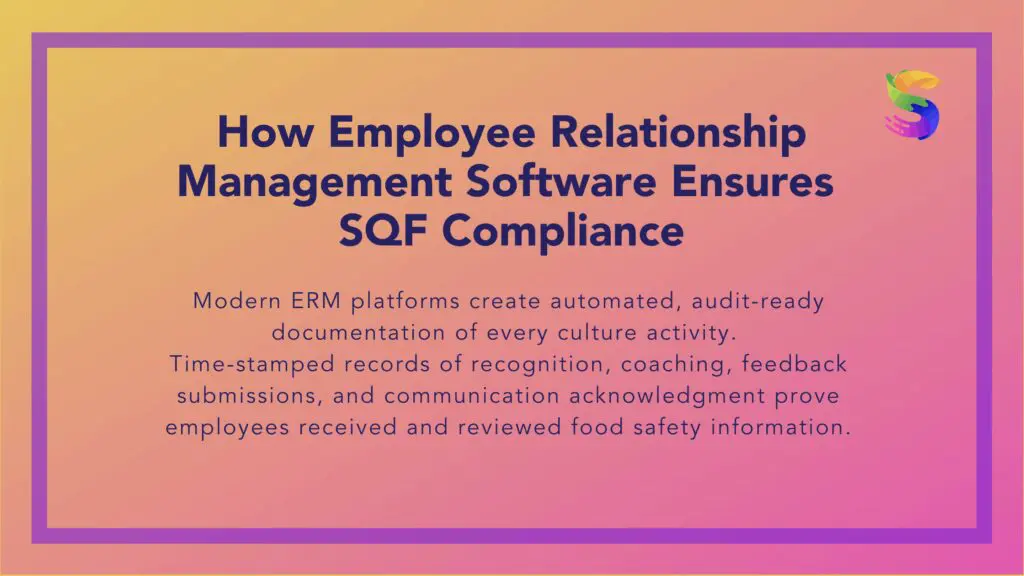
How Employee Relationship Management (ERM) Software Ensures Compliance
Modern ERM platforms—purpose-built for frontline operations—solve the SQF Edition 10 compliance challenge while simultaneously improving actual employee engagement, food safety culture, and operational performance.
Here’s how:
1. Automated, Audit-Ready Documentation
The Compliance Benefit: ERM platforms automatically create time-stamped, tamper-proof records of every culture and engagement activity:
- Supervisor-employee recognition with date, time, sender, recipient, and reason
- Coaching conversations documented in real-time during the interaction
- Feedback submissions from employees with tracking through resolution
- Communication acknowledgment proving employees received and reviewed information
- Participation tracking in food safety initiatives and meetings
The Auditor Sees: Complete, consistent documentation across all shifts, all supervisors, all time periods. No gaps, no retroactive entries, no suspicious patterns. Clear evidence of an active, ongoing food safety culture.
Real Example: An auditor asks, “Show me employee engagement from Q1-Q2.” You generate a report showing 847 recognition moments, 213 coaching conversations, 156 food safety meeting participants, and 34 employee suggestions with documented management responses—all automatically captured through normal supervisor workflows.
2. Real-Time Two-Way Communication
The Compliance Benefit: Employees can submit feedback, concerns, or suggestions directly through the platform (via text message or app). Management receives immediate notification and can respond quickly, with all communication tracked and audit-ready.
The Auditor Sees: A functioning, documented feedback loop where employees regularly share input, management responds within defined timeframes, and issues are resolved with documented outcomes proving continuous improvement.
Real Example: An employee notices improper handwashing by a co-worker and reports it through the ERM platform. The report is timestamped, routed to the supervisor immediately, corrective coaching is documented within 2 hours, and follow-up observation confirms behavior change. All of this creates a defensible audit trail demonstrating active employee participation in food safety.
3. Consistent Recognition Across All Shifts
The Compliance Benefit: ERM platforms make recognition frictionless—supervisors can acknowledge food safety behaviors in seconds. This consistency satisfies auditors’ requirement for regular, documented positive reinforcement of safe practices.
The Auditor Sees: Equitable recognition across all shifts and supervisors, with specific, documented examples of employees being acknowledged for food safety behaviors—not just production output.
Real Example: During an audit, you demonstrate that employees who properly completed temperature logs received recognition an average of 3.2 times per month across all shifts, proving a culture where food safety behaviors are consistently valued and reinforced.
4. Proven Competency and Training Effectiveness
The Compliance Benefit: When supervisors communicate food safety updates or training through ERM platforms, the system tracks who received the information, when they acknowledged it, whether questions were asked, and if follow-up coaching occurred.
The Auditor Sees: Not just that training happened, but that information was received, understood, and applied—meeting the competency-based training requirement with documented proof.
Real Example: A new allergen handling procedure is communicated through the ERM platform. Reports show that 98% of production employees acknowledged receipt within 24 hours, 12 employees asked clarifying questions (all answered and documented), post-implementation observations confirmed understanding, and recognition was given to employees who demonstrated proper execution.
Beyond Compliance: The Real Business Benefits
Here’s what makes ERM platforms uniquely valuable: They don’t just check compliance boxes. They actually improve the things SQF Edition 10 cares about.
Reduced Food Safety Incidents
When employees feel engaged, valued, and heard, they become active participants in food safety rather than passive rule-followers.
Data: Food manufacturers using ERM platforms report 40-60% reduction in food safety deviations and near-miss incidents within 90 days.
Why: Employees who receive regular recognition and feel their concerns are heard take personal ownership of quality and safety outcomes. They identify risks early and speak up without fear.
Lower Turnover = Better Food Safety
High turnover creates food safety risk. New employees make more mistakes, experienced knowledge leaves with departing workers, and training gaps create vulnerabilities.
Data: ERM customers achieve 50-71% turnover reduction within 90 days.
Why: Engaged employees stay. Retained employees become food safety experts who protect your operation and mentor new hires effectively.
Faster Issue Resolution
When employees feel safe reporting concerns, problems get identified and resolved before they become contamination events or audit findings.
Data: Facilities with ERM platforms resolve reported issues 65% faster than those using manual systems.
Why: Real-time reporting and automated escalation ensure issues don’t languish in paper-based workflows or go unreported due to fear or inconvenience.
Measurable Culture Metrics
SQF Edition 10 requires culture-related metrics. ERM platforms provide them automatically.
What You Can Measure:
- Participation rates in food safety initiatives
- Response time to employee feedback
- Recognition frequency for food safety behaviors
- Training acknowledgment and competency verification rates
- Issue identification and resolution speed
Data: These metrics demonstrate continuous improvement to auditors and help leadership make data-driven culture decisions.
Stronger Food Safety Culture
Culture isn’t built through posters on break room walls. It’s built through hundreds of daily interactions between supervisors and employees.
Data: Employee surveys show 82% improvement in “I feel comfortable raising food safety concerns” scores after ERM implementation.
Why: When supervisors have tools to recognize good behaviors instantly and respond quickly to concerns, psychological safety and trust develop naturally—creating the foundation of strong food safety culture.
Implementation Roadmap: Getting SQF Edition 10-Ready in 90 Days
Concerned about the 2026 implementation deadline? Here’s a practical plan:
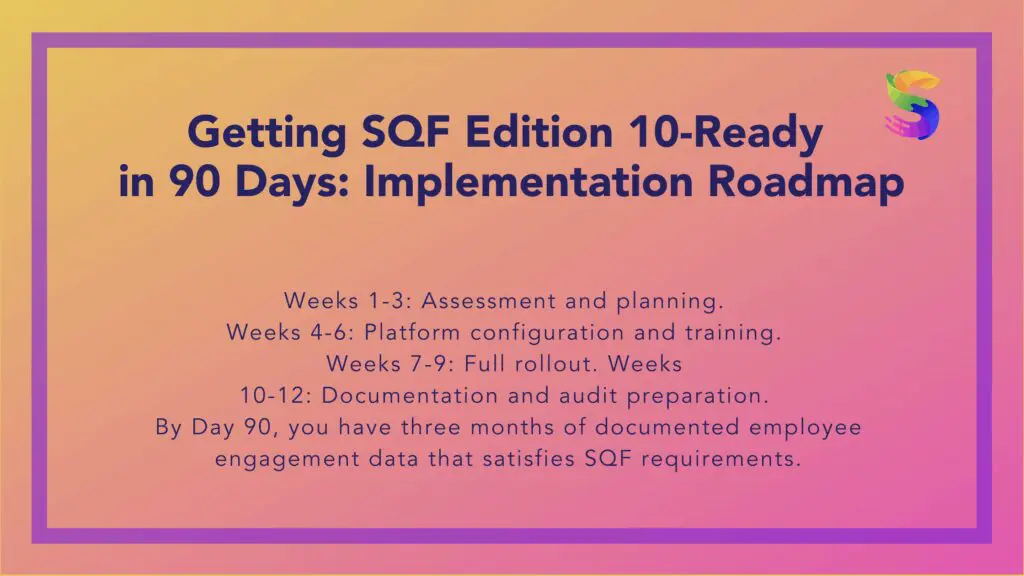
Weeks 1-3: Assessment and Planning
- Document current food safety culture and engagement practices
- Identify gaps relative to SQF Edition 10 requirements
- Select ERM platform and initiate configuration
- Designate internal champion for rollout
- Define culture metrics you’ll track
Weeks 4-6: Platform Configuration and Training
- Configure ERM platform for your facility
- Train supervisors on recognition, documentation, and feedback systems
- Create SQF Edition 10-specific workflows (food safety recognition categories, incident reporting, competency tracking)
- Launch pilot with one shift or department
- Begin capturing baseline culture metrics
Weeks 7-9: Full Rollout
- Expand to all shifts and departments
- Monitor adoption and engagement rates
- Gather supervisor and employee feedback
- Refine workflows based on real-world use
- Ensure all employees understand how to participate
Weeks 10-12: Documentation and Audit Preparation
- Generate compliance reports showing culture plan implementation
- Review documentation completeness against SQF Edition 10 checklist
- Create audit response package with evidence
- Conduct internal mock audit focused on culture requirements
- Identify and address any remaining gaps
By Day 90: You have three months of documented, consistent, authentic employee engagement and food safety culture data that satisfies SQF Edition 10 requirements while actually improving your operation.
Schedule a compliance consultation to create your customized 90-day implementation plan.
Common Questions About SQF Edition 10 and ERM
Q: Can we use our existing HRIS for this?
Most HRIS platforms aren’t designed for frontline engagement or food safety culture documentation. They’re too complex for supervisors to use consistently during shifts, don’t capture the real-time, two-way interactions auditors want to see, and lack the mobile-first design frontline operations require.
Q: What if our employees don’t have smartphones?
Modern ERM platforms work via text message—no smartphone required. Recognition and communication reach employees on basic phones, and supervisors handle documentation through their mobile devices.
Q: How much does implementation cost compared to audit failure?
A failed SQF audit can cost millions in lost business, re-certification efforts, and customer relationships. ERM platforms typically cost $5-12 per employee monthly—a fraction of the risk cost.
Calculate your potential savings.
Q: Will this add administrative burden to our supervisors?
The opposite. ERM platforms reduce administrative time by 50% while improving documentation quality and compliance readiness. What used to take 10 steps and 15 minutes now takes 2 clicks and 30 seconds.
Q: How does this integrate with our current food safety management system?
ERM platforms complement (not replace) your existing food safety systems. They focus specifically on the culture and people side—employee engagement, recognition, coaching, communication—while your HACCP, allergen, and preventive control systems handle the technical food safety elements.
The Bottom Line
SQF Edition 10’s food safety culture requirements represent a fundamental shift in food safety compliance—one that recognizes the direct connection between engaged employees and safe food production.
You have two choices:
Option 1: Scramble to create paper-based systems that technically check compliance boxes but don’t actually improve employee engagement or food safety culture. Hope auditors don’t dig too deep into authenticity and effectiveness.
Option 2: Implement modern ERM technology that creates authentic engagement, generates audit-ready documentation automatically, and simultaneously improves turnover, productivity, food safety culture, and business outcomes.
SQF Edition 10 releases in July 2025, with auditing beginning in early 2026. The question is whether you’ll meet compliance requirements through administrative burden or through genuine transformation.
Get SQF Edition 10-Ready in 90 Days
Secchi’s Employee Relationship Management platform was built specifically for food manufacturing operations. Our customers maintain SQF certification while achieving 71% turnover reduction, 50% fewer attendance issues, and measurably stronger food safety cultures.
Schedule a compliance consultation to review your current state and create a customized 90-day implementation plan aligned with SQF Edition 10 requirements.
View our case studies to see how food manufacturers achieved both compliance and operational excellence.
Calculate your ROI from reduced turnover, improved productivity, and compliance readiness.
Explore our resources including white papers on building food safety culture in manufacturing operations.
Don’t let SQF Edition 10 catch you unprepared. Turn compliance into competitive advantage.
About the Author: Mike White is the founder of Secchi and a former HR leader who spent years in food manufacturing operations. He frequently speaks about food safety culture and employee engagement at industry conferences.
Related Resources:
See how Secchi can drive positive change in your organization.
With Secchi, leaders across your entire organization have access to turn-by-turn leadership directions and actionable data that guides them on how to engage their teams through recognition, coaching, engagement, and accountability.
Want more leadership and engagement strategies straight to your inbox?
Subscribe here.